

10 Mobile App Ideas for 2026, Backed by Market Data
You've probably read a list of mobile app ideas before. Maybe several. They all carry the same twenty entries: fitness tracker, meditation app, food delivery, AR shopping assistant, blockchain something.
None of them tell you the three things you actually need to know: whether people want it, what it earns, and how crowded the field already is.
That gap is expensive. The average app keeps only 2–5% of its users 30 days after install (a 2025 retention benchmark). Pick the wrong idea and you'll spend six months building something the market already rejected. We got tired of watching that happen, so we built this list differently: every idea below had to pass a data filter first — estimated download and store revenue data from the app market, not vibes.
Here's the difference in one line. Most lists give you ten more ideas to daydream about. This one gives you ten markets with numbers behind them.
Why Most App Idea Lists Fail You
Lists of mobile app ideas share a strange property: they keep recommending the same apps that already exist.
Read five of them back to back and you'll find the same fitness tracker on all five, recommended to the same readers, with no mention of the 400 other fitness trackers it will compete against. The advice isn't wrong exactly. It's just unpriced. Nobody tells you what the idea costs to pursue or what its odds are.
The odds matter because they're rough. AppsFlyer analyzed 1.3 billion installs across 2,200 Android apps and found a 46.1% overall uninstall rate in 2024, with over half of apps getting deleted within a month of install (AppsFlyer's uninstall report). One development agency that shipped 353 client apps in 2025 reported an 80% failure rate, and located the kill zone precisely: apps that held 28% of users at day 30 usually went on to succeed, while apps that fell to 3% almost never recovered (Trango Tech's post-mortem).
So the useful question isn't "what are some good mobile app ideas?" It's "which ideas have demand I can verify before I write a line of code?" That's the question this article answers.
How We Picked These 10 Ideas
Every list of mobile app ideas has selection criteria. Most of them are vibes. Ours are measurable, and you can run the same screen yourself.
We started from app market charts covering 7M+ apps across the App Store and Google Play in 40+ markets (we use Appark's app rankings, updated approximately every three hours across free, paid, and top-grossing charts). Each idea below had to clear three bars:
- Demand is visible. The category or a close comparable app shows steady or growing downloads over the last 30 days, not a post-launch spike followed by a cliff.
- Money is moving, but not everyone has it. Someone in the niche earns real revenue, while the top 10 is still weak enough for a solo developer to break in.
- Competition leaves room. If the top three apps are all funded incumbents with 7-figure marketing budgets, we skipped it. Underserved app niches with high demand are where small teams win.
We deliberately kept this list to ten instead of fifty. Ten markets with data you can verify beats fifty recycled ideas you can't.
The 10 Mobile App Ideas
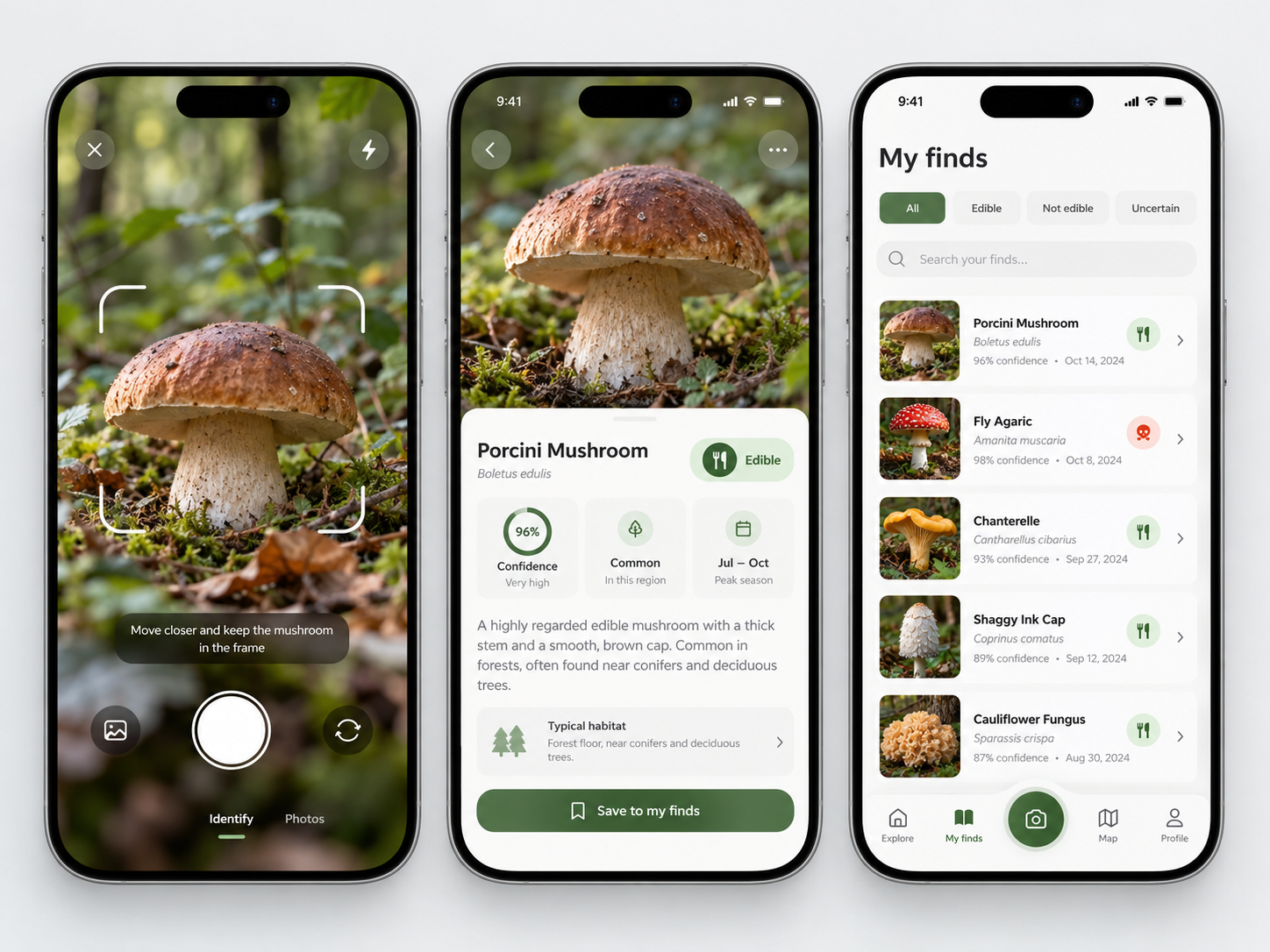
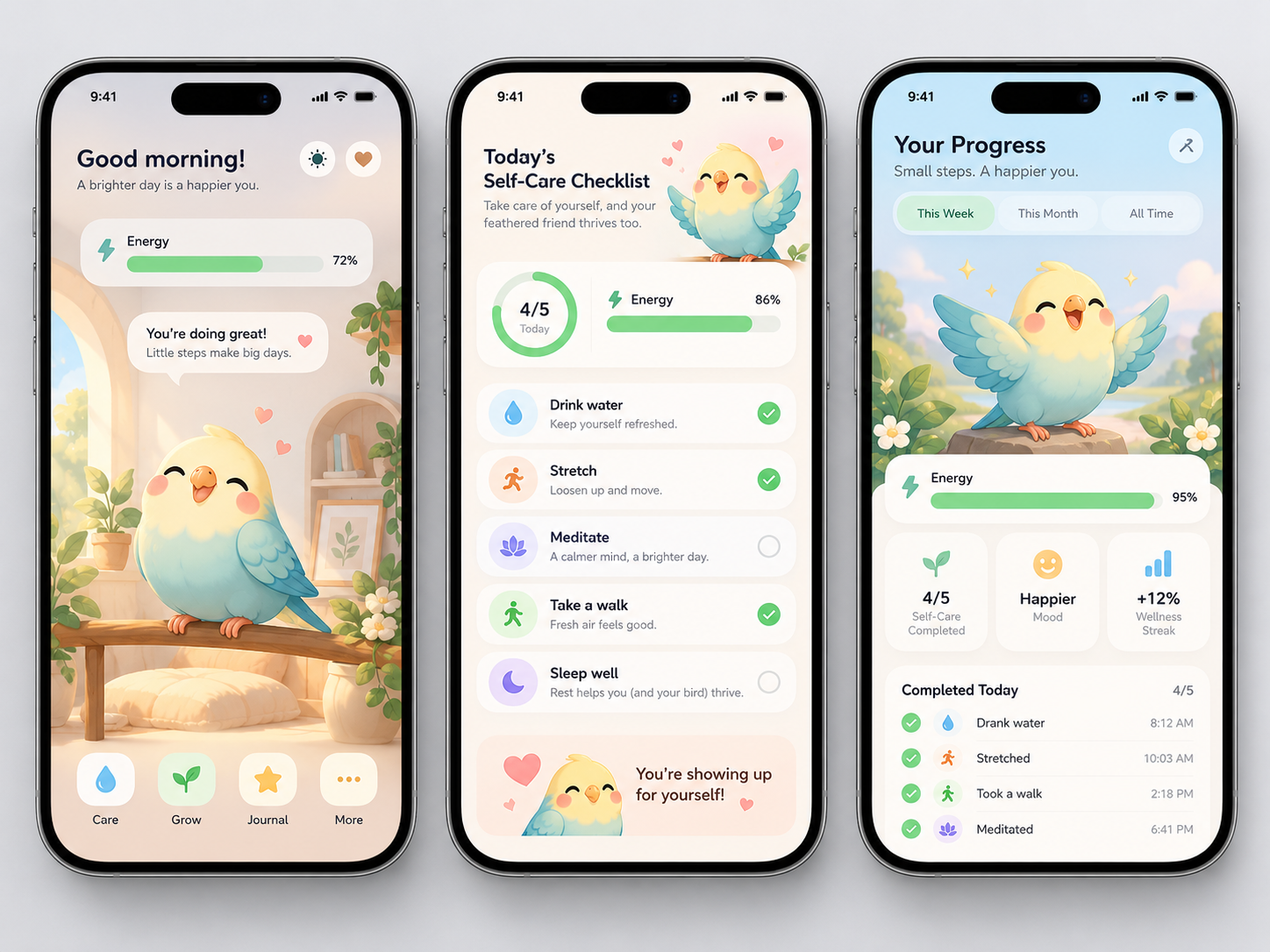
Here they are, grouped by category. Each entry gives you the problem, who pays, and how it makes money. Two of the ideas — the ones where a picture does the most work — come with a concept mockup; the rest are text. The mockups are AI-generated illustrations, not real products. The real evidence lives in the validation section, where we've marked the Appark screenshots to capture.
AI mobile app ideas
1. AI identifier for a specific domain (mushrooms, birds, insects, watches). Plant identification proved the model: a subscription app that identifies plants from a photo turned into a nine-figure business, and the mechanic is now repeatable. Plants are taken. Mushrooms, birds, and watch authentication are not — each has a hobbyist audience that will pay for accuracy because the cost of being wrong is real (a misidentified mushroom, a fake watch). Money: subscription, $30–40/year.
2. Photo-based nutrition tracking for a specific diet. Cal AI proved "snap a photo, get your calories" at scale and was acquired by MyFitnessPal in December 2025 (TechCrunch). Generic calorie counting is now a red ocean. The open lane is diet-specific: diabetic-friendly, renal, bodybuilding prep, low-FODMAP. Same mechanic, narrower promise, a person you can actually market to by name.
3. AI study companion for one subject. Language learning is a knife fight where Duolingo spends like a category king. Nursing exams, pilot certification, bar prep, and trades licensing have smaller audiences with far higher willingness to pay — a $50 NCLEX cram app is cheap next to a failed exam. AI question generation makes the content cost near zero.
Health mobile app ideas
4. Gamified self-care companion. Finch turned self-care into keeping a virtual pet alive and it worked: a 4.9 App Store rating, a top-10 US Health & Fitness ranking, and a habit loop that doesn't rely on willpower. The founders have said they shipped eight failed versions before the pet concept clicked. The lesson isn't "clone Finch." It's that habit apps win by giving users a reason to return that isn't discipline.
5. ADHD-friendly task manager. Finch's most vocal users are in ADHD communities — people who describe being unable to keep up with themselves but able to keep up with a pet. No major task manager is built for that brain: short time horizons, dopamine-driven loops, zero shame mechanics. It's a real, identifiable audience with no product that fits it.
6. Medication reminder with a caregiver loop. The user is a senior; the buyer is their adult child. That split matters. Reminders, missed-dose alerts to family, and refill tracking in one dead-simple interface. Design discipline is the moat: mainstream apps keep adding features until seniors can't use them, so staying simple is itself the differentiator.
Mobile app ideas that make money
7. Side-hustle income tracker with tax estimates. Gig and freelance income is scattered across platforms, and the tax surprise in April is a genuine fear. An app that consolidates earnings and estimates quarterly taxes answers a question this audience asks monthly. The tools built for salaried households don't fit them, and this audience keeps growing.
8. Invoice chaser for freelancers. Nobody enjoys chasing payments. Automatic, politely escalating invoice reminders get freelancers paid faster, and they'll happily pay a flat monthly fee for it. It's a thin app with one job and no content treadmill — the best kind of mobile app idea for a solo developer.
Niche and local
9. Local loyalty aggregator for independent shops. A shared punch-card app for the coffee shop, the bookstore, and the dry cleaner on one block. The math is easy to sell: At $29 per month per shop, 30 participating businesses would generate $870 in monthly recurring revenue from a single neighborhood, and every shop you sign makes the app more useful to the next. Local apps win by owning one neighborhood before expanding.
Travel
10. Road trip planner for a specific vehicle or region. Roadtrippers proves the demand — more than 38 million trips planned to date, and a category leader that's US-centric and generalist. RV routing exists; EV road tripping is genuinely unsolved: charging-time-aware routes, charger reliability, weather-drained range. Or go geographic, because America is not the only place people drive. Money: subscription ($35–60/year is the proven band), plus affiliate revenue from bookings.
Which Idea Is Right for You?
The best list of mobile app ideas is useless if it hands a startup-grade idea to someone who wanted a weekend project. Pick by what you're actually trying to get out of it.
If you're a student building a portfolio: choose #1, #5, or #8. You want simple app ideas for beginners that ship in weeks and show real craft. #8, the invoice chaser, is the sleeper: real users, real reviews, no retention pressure, and a clean technical story for interviews.
If you're building a side income: choose #1, #7, #8, or #10. Short paths to revenue, low support burden. #7 (income tracker) and #8 (invoice chaser) are the purest — thin tools, one price, no content treadmill.
If you're building a startup: choose #2, #5, #6, or #10. A market big enough to matter, with a data moat or distribution angle incumbents can't copy fast. #2 (diet-specific nutrition) is the sharpest risk/reward: Cal AI proved the mechanic, and the diet-specific variants are still open.
Whichever you pick, do the next section before writing code. It takes an afternoon and it's the difference between a bet and a guess.
How to Validate Any Idea in 5 Steps
Here's the process we use, and you can run it with app market research tools before writing code. An afternoon per idea.
Step 1: Check the demand curve. Open Appark’s Downloads & Revenue Rankings and review estimated downloads, estimated store revenue, and period-over-period changes for your target category. Steady or climbing downloads, and grossing charts that show money moving. A category where the top apps are all declining is a warning, not an opportunity.
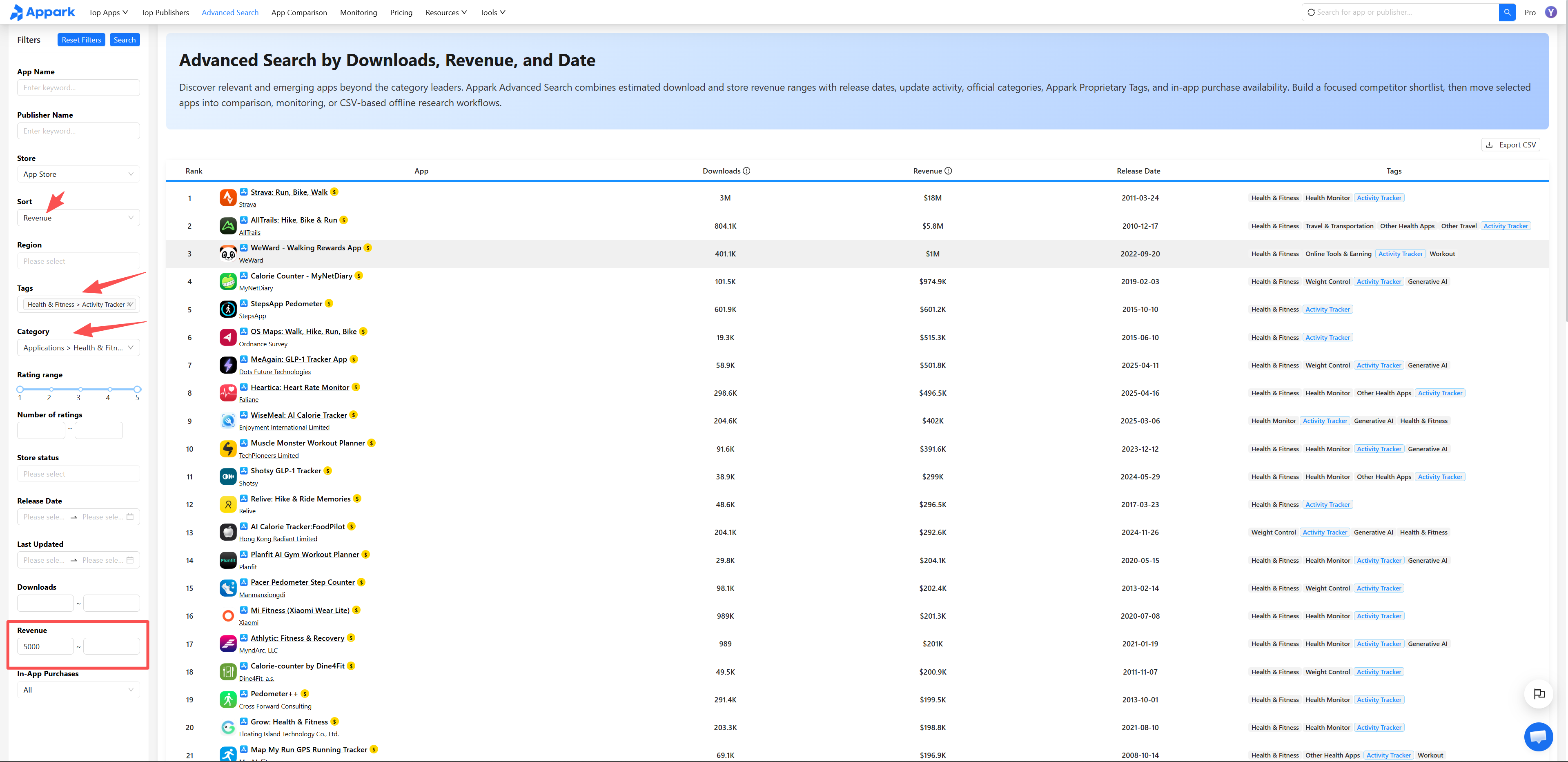
Step 2: Size the competition. Use advanced app search to filter 7M+ apps by category, download range, and revenue range. Count how many apps in your niche generate more than $5K in estimated monthly store revenue. Zero means no one's proved the market. A dozen with weak reviews means room. A few well-funded winners with 4.8 ratings means walk away.
Step 3: Benchmark the money. Pick 3–5 comparable apps and compare them side by side on downloads, revenue, and ranking trends. This sets your realistic ceiling and floor. If Appark estimates the #10 app in your niche at $3K in monthly store revenue, that's your starting expectation, not the leader's nine figures.
Step 4: Estimate reachable revenue. Take the median revenue of your comparables, assume you land below it in year one, and ask if that number justifies your time. $2K a month from a niche app is a life-changing side income and a failed startup. Know which one you're building.
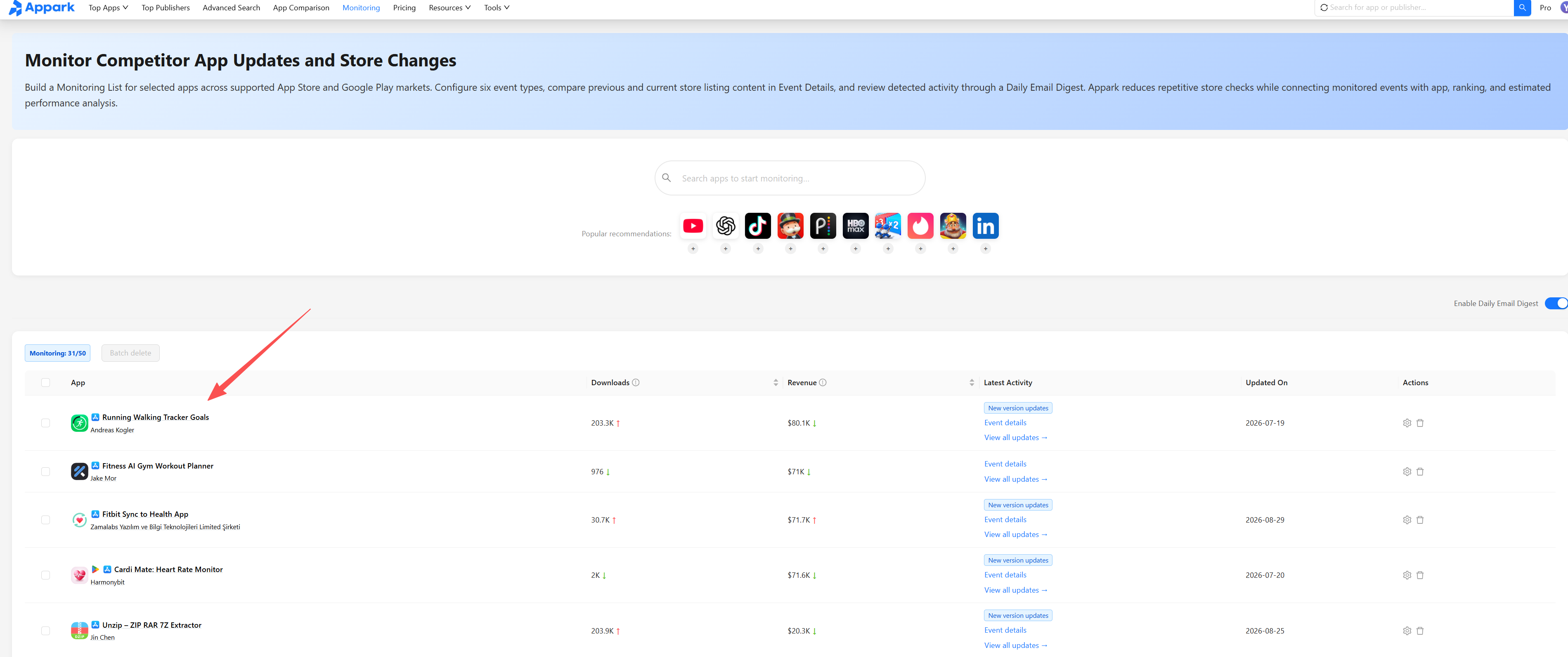
Step 5: Watch before you build. Set up monitoring on your comparables for 30 days. Ranking swings, new releases, and rating changes tell you how fast the niche moves. If nothing changes in 30 days, it's stable enough to enter. If a new app rockets up the charts, study what it did before you commit.
One honest caveat: market data validates demand, not your execution. Talking to ten people in the target audience before building is still worth doing. The data tells you the river is flowing; the conversations tell you whether you can swim.
Why Good Ideas Still Fail
Even validated mobile app ideas die. Here's what kills them, with numbers.
The 30-day cliff. Across all app categories, average day-1 retention is 21–24% and day-30 retention is 2–5% (retention benchmark)). Trango Tech's 353-app dataset found that apps holding ~28% at day 30 had a 72% chance of eventual success; apps at 3% had under 5%. Your idea is fine. Your onboarding is the problem. If your first-run experience takes more than 60 seconds to deliver value, users are gone.
Uninstalls arrive fast. Over half of apps get uninstalled within a month, per AppsFlyer's analysis of 1.3 billion installs (uninstall report). The takeaway: promise less in your store listing, deliver more in the app. Overpromising converts installs into churn and churn into a worse ranking.
Distribution is unbudgeted. Cal AI's early growth came from systematic influencer marketing on TikTok, not a Product Hunt post, and even then it took paid ads to push past the plateau (TechCrunch). Wordle spread because the share format was built into the product, and the game still sold to the New York Times for a "low seven figures" (Wikipedia). If you can't name your first 100 users and how they'll find you, your idea isn't ready, no matter what the download data says.
FAQ
What makes a good app idea in 2026?
A specific person with one expensive problem, plus evidence that others already pay to solve it. "Meditation app" fails that test; "wind-down app for night-shift nurses" passes. Look for existing apps generating meaningful estimated store revenue in the niche, and weak reviews among the leaders, which means room to do better.
How do I validate an app idea without coding?
Use app market data: pull the category's top charts for download trends, search the niche by revenue range to find comparable, and benchmark 3–5 of them side by side. Then watch them for 30 days. The five-step process above takes an afternoon, requires zero code, and beats asking your friends.
Which app categories earn the most money?
In 2025 — the latest full year of data — non-game apps out-earned games in in-app revenue for the first time, 84.1B to 82.7B, with subscriptions driving most of the growth (Business of Apps). Finance, health, education, and AI utilities monetize best per user, and iOS remains the revenue platform at 70.5% of in-app purchase spend.
How much does it cost to build an app in 2026?
Depends on who builds it. A solo developer or no-code builder can ship an MVP for the cost of tools and time. A contracted MVP from a small studio may cost around $15K–$40K, while larger agency projects can start at $50K and go considerably higher. Costs vary widely by scope, region, platform, and compliance requirements.
Are simple mobile app ideas still worth building?
Yes. Flappy Bird was a tap-to-flap game that peaked at $50K a day in ad revenue before its creator pulled it. Simple apps with one sharp hook beat ambitious apps with no hook. The bar is specificity, not complexity.
Put the Data to Work
A list of mobile app ideas is only as good as the market behind it. Pick the one that fits your goal, then spend an afternoon running the five-step check above. Pull your category's charts, filter by estimated store revenue range, and start your free market research on Appark — no guesswork, just numbers.