


App Market Research: How to Validate Your App Idea with Real Market Data
You can spend three months building an app, polish the onboarding, buy a little traffic, and still discover after launch that the market was crowded before you wrote the first line of code. That is the problem app market research is supposed to solve.
The useful version of market research is not a 60-page deck full of generic TAM charts. It is a decision process. Before you commit serious time or money, you want evidence that people already care about the problem, that at least some of them are willing to pay, and that a new product still has a realistic path into the market.
For mobile products, that evidence is unusually visible. App stores expose rankings, reviews, pricing and update history; market-intelligence tools add modeled download and revenue estimates; communities such as Reddit reveal what users still dislike. Put those signals together and the research becomes much more practical than simply asking whether an industry is “growing.”
This guide shows how to do app market research step by step, using an AI video generator as the running example. The goal is not to prove that AI video is a good idea. It is to reach a better Go, Pivot, or No-Go decision before development gets expensive.
What Is App Market Research?
App market research is the process of studying demand, competitors, users, downloads, revenue, rankings and market trends to judge whether a mobile app opportunity is worth pursuing.
It sits between traditional market research and product analytics. Traditional research might tell you how large an industry is or how consumers describe a problem. Product analytics tells you what happens inside an app you already own: retention, activation, conversion, churn. App market research looks outward. It asks what is happening across the category before — and after — you enter it.
For a founder considering an AI video app, that means answering questions such as: Are several AI video products growing, or only one famous brand? Are users actually paying? Can apps launched in the last 12–24 months still break into the category? Which complaints repeat across reviews? Does the opportunity lie in a general-purpose tool, or in a narrower workflow such as product videos for ecommerce sellers?
This is also where mobile app intelligence becomes useful. Market intelligence provides the external performance data; primary research such as interviews and prototype tests helps explain the behavior behind those numbers.
Primary vs. secondary research
A strong research process uses both. Secondary research is usually the fastest place to start because the data already exists: App Store and Google Play rankings, estimated downloads and revenue, competitor pricing, reviews, market reports, Google Trends and community discussions. Primary research comes later, when you have a narrower hypothesis worth testing through interviews, surveys, landing pages or prototypes.
For a small team, the order matters. There is little value in interviewing 30 people about a product category if basic market data already shows weak demand and almost no monetization. Conversely, if the category is growing and recent entrants are succeeding, interviews can focus on a much sharper question: what are users still unhappy about, and would they switch for a better solution?
What Should App Market Research Tell You Before You Build?
Good app market research should reduce uncertainty around four things: demand, monetization, competition and accessibility.
Demand is more than Google search volume. You want to see multiple apps attracting users over time, not one viral hit. Rankings, download trends and the performance of new entrants are stronger evidence that a category has depth.
Monetization matters because downloads and business quality are not the same. A smaller app that generates strong revenue may have a better subscription model or a higher-value audience than a larger free app. If you are evaluating a commercial opportunity, pair download data with app revenue estimates instead of treating installs as the only scorecard.
Competition should be studied in layers. Category leaders show what the ceiling looks like, but recent entrants often tell you more about what is achievable today. If every successful app launched five years ago, that is a different market from one where several products released last year are still climbing.
Finally, accessibility asks the question that headline market-size reports rarely answer: how much of this market could a new team realistically compete for? That is what turns raw app market data into a product decision. A huge category dominated by two incumbents can be less attractive than a smaller, fragmented category with visible user pain and several rising challengers.
How to Do App Market Research: A 7-Step Framework
The following framework is deliberately practical. You can run a first pass in a few hours, then deepen the parts that actually affect the decision.
Step 1: Define the market tightly enough to research
“AI apps” is not a market definition. Neither is “fitness” or “productivity.” Before collecting data, specify the product type, target audience, geography, store and time horizon.
For our running example, a workable brief would be:
Research consumer AI video-generation apps in the United States across iOS and Android, with particular attention to products launched in the last two years, to determine whether a new general-purpose app can still gain traction or whether a narrower use case is more attractive.
That sentence does something important: it gives the research a decision. Without that, the work easily turns into browsing charts without knowing what would change your mind.
Step 2: Measure demand with downloads, revenue and rankings
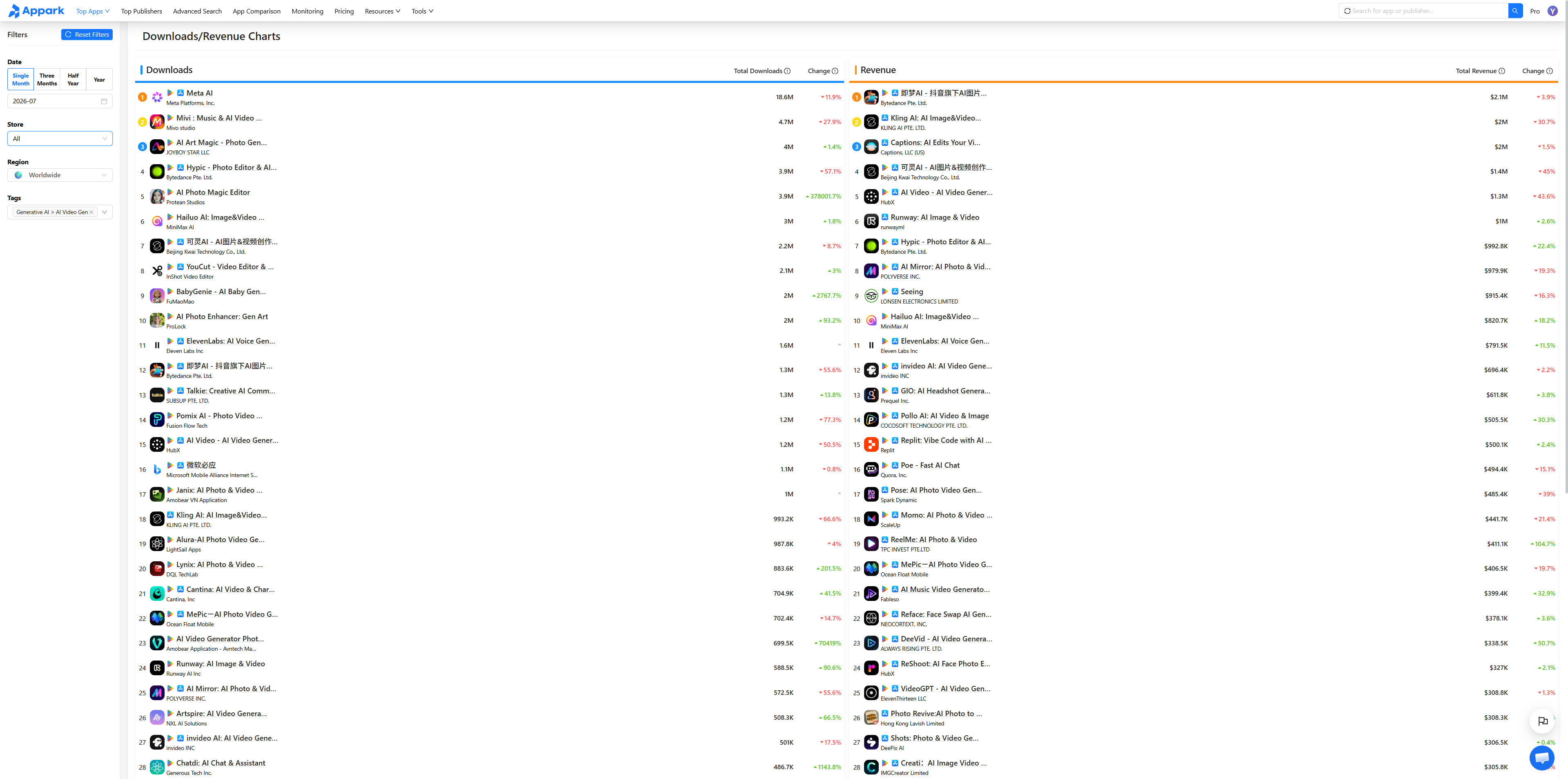
Start broad enough to understand the category, then narrow. Use app-store charts and a market-intelligence platform to look at current leaders, download trends, estimated revenue and ranking movement across a consistent period.
Appark's Downloads/Revenue Charts are useful here because they let you compare market-level performance by store, region and time range. Do not ask only “Which app is biggest?” A better question is “Are several apps showing sustained demand, and are any of them recent entrants?”
The AI market provides a good example of why this distinction matters. In Sensor Tower's State of AI Apps 2026: APAC Edition, global generative-AI mobile IAP revenue reached $6.1 billion between Q2 2025 and Q1 2026, up 232% year over year. More relevant to our example, Sensor Tower describes AI Image & Video Generation as a fast-growing vertical with a fragmented competitive landscape, unlike the increasingly concentrated AI-assistant category. That does not prove that an AI video startup will win, but it is a stronger starting signal than “AI is hot.”
The point of this process is to separate category-level enthusiasm from app-level evidence. If several products are growing and monetizing, the market deserves a closer look. If one brand captures nearly everything, the opportunity may be much narrower than the headline numbers suggest.
Step 3: Find direct competitors — especially recent entrants
Once you know demand exists, build a focused competitor set. A useful group is usually 10–15 apps: a few leaders, several direct competitors, a handful of newer entrants and one or two niche products with unusual positioning.
This is where structured search is more useful than manually browsing store results. Appark's Advanced Search can filter apps by store, region, tags, category, release date, downloads, revenue and other attributes. For app market research, release date is particularly valuable because it helps answer a hard question: Can an app that entered recently still earn meaningful attention?
For an AI video project, I would not stop at the best-known names. I would deliberately look for products released within the last 12–24 months that have already crossed a meaningful traction threshold, then inspect their positioning, pricing and feature focus. If several newer apps are succeeding, that is evidence of market accessibility. If nearly all traction belongs to incumbents, treat that as a caution signal.
If you need a full mobile app competitor analysis, see the separate app competitive analysis guide. The distinction is useful: competitor analysis is one part of app market research, not the whole exercise.
Step 4: Compare growth and monetization over time
Static numbers are easy to misread. If App A has twice the downloads of App B today, that tells you who is larger; it does not tell you who is gaining ground.
Put several competitors on the same timeline and compare downloads, estimated revenue and rankings. Appark's App Comparison is built for this kind of side-by-side view. The most useful patterns are directional:
| Pattern | What it may suggest |
|---|---|
| Downloads ↑ and revenue ↑ | Healthy growth; worth deeper analysis |
| Downloads ↑ and revenue flat | Acquisition is working better than monetization |
| Downloads flat and revenue ↑ | Better conversion, pricing or user quality may be driving growth |
| One app dominates both | Category may be concentrated; differentiation must be stronger |
Treat these as clues, not proof. A revenue increase after a version update may coincide with the release, but paid acquisition, seasonality or featuring could also explain the movement. Good research identifies patterns worth investigating without pretending correlation is causation.
Step 5: Read what users still want
Market data tells you where something interesting may be happening; user research helps explain why.
Read one- and two-star reviews for direct competitors, then sample recent positive reviews so you do not build a strategy around complaints alone. Search Reddit and specialist communities for recurring language around pricing, missing features, quality, speed and workflow friction. The goal is not to collect isolated quotes; it is to find repeated problems across multiple sources.
Suppose AI video users repeatedly complain that general-purpose tools require too many steps to turn product images into usable social ads. That is not yet a product opportunity. It is a hypothesis: ecommerce sellers may value a narrower “product image → short ad” workflow. The next step is to test that hypothesis with interviews or a lightweight landing page.
This is where mobile app market research becomes materially more useful than a keyword-volume report. You are connecting observed market behavior to a concrete user problem.
Step 6: Estimate the accessible opportunity, not just TAM
Traditional TAM/SAM/SOM analysis is useful for investors, but indie developers often need a different question: Can a team like ours enter this market and reach customers at all?
Judge the opportunity across five signals:
- Demand: several apps attract sustained downloads.
- Monetization: more than one competitor converts demand into revenue.
- New-entrant success: recent launches can still grow.
- Market concentration: value is not captured entirely by one or two incumbents.
- Unmet need: users repeatedly describe a problem that existing products do not solve well.
A useful counterexample comes from short-drama apps. Sensor Tower reported that global short-drama downloads exceeded 850 million in Q1 2026, up 140% year over year, while IAP revenue reached roughly $750 million. FreeReels alone passed 100 million installs in the quarter, and newer challengers such as NetShort were also accelerating. Those figures show a real, expanding market — but they do not mean short drama is automatically an accessible opportunity for a two-person app team, because content production, localization and paid acquisition are central to the business. The same data that validates demand can also reveal execution risk. See Sensor Tower's 2026 report.
That distinction — big market versus accessible market — is one of the most useful outcomes of the exercise.
Step 7: Monitor the market after the decision
Markets keep moving while you build. A competitor can change pricing, release a major feature or enter your target country in the months between research and launch.
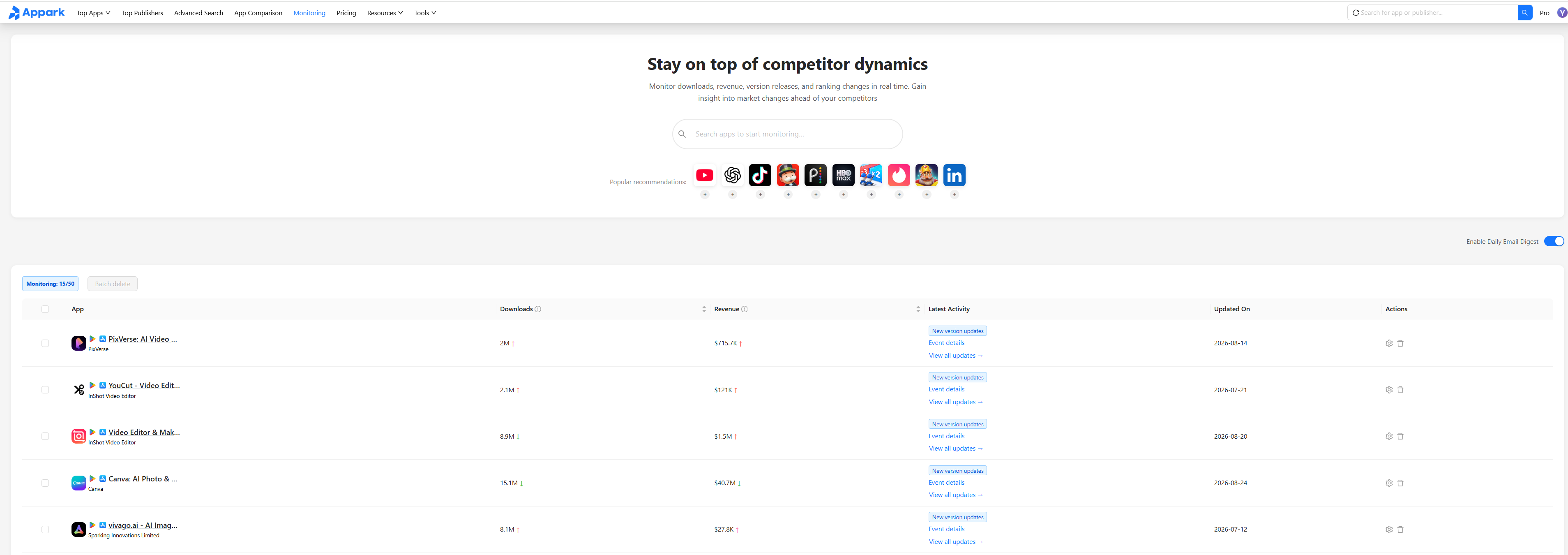
Once you have identified the five to ten apps that matter most, add them to a watchlist. Appark's Monitoring tracks downloads, revenue, rankings, version releases, rating changes and price adjustments, with daily email digests available for ongoing review.
Do not react to every small movement. Instead, look for meaningful combinations: a release followed by sustained rank improvement; a price change accompanied by better revenue; a new entrant climbing for several weeks rather than one day. Treat app market research as a loop — research, decide, build, monitor, learn, adjust — rather than a document you finish once and forget.
Turn the Research Into a Go, Pivot or No-Go Decision
The most common failure in app market research is finishing with a spreadsheet instead of a decision. Use a simple scorecard to force the trade-offs into the open.
| Signal | Strong | Caution |
|---|---|---|
| Demand | Several apps show sustained growth | One viral winner drives most demand |
| Monetization | Multiple competitors earn meaningful revenue | Downloads are high but revenue is weak |
| New entrants | Recent apps can still break through | Rankings are controlled by incumbents |
| Competition | Market is fragmented enough to differentiate | A few firms dominate acquisition and revenue |
| User pain | Repeated unresolved complaints | Existing products satisfy the core job well |
A Go means the evidence is strong enough to keep validating, not that success is guaranteed. A Pivot means the category looks attractive but the original positioning is too broad. For our AI video example, the rational result might be: “General-purpose AI video is crowded, but product-video generation for ecommerce sellers deserves a focused test.” A No-Go is appropriate when weak demand, poor monetization, entrenched competitors and limited differentiation appear together.
Avoid universal thresholds such as “$100K monthly revenue equals a good market.” Categories behave differently. Compare apps against peers in the same category, geography and business model. Relative performance is usually more useful than an arbitrary number.
App Market Research Tools and Sources: What You Actually Need
You do not need an expensive stack to begin. A sensible app market research toolkit combines three source types.
Market-intelligence tools help with downloads, revenue, rankings, historical trends and competitor discovery. Sensor Tower and AppMagic serve broad market-intelligence use cases, AppTweak has a strong ASO focus, and Appark is designed around rankings, competitor discovery, comparison and monitoring. If you are choosing between platforms, see the dedicated guide to app market research tools rather than turning this article into another tool list.
Public sources provide context that market data cannot. App Store and Google Play listings show pricing, screenshots, reviews and update history. Google Trends can reveal changes in broader search interest. Competitor websites show positioning and packaging. Reddit, YouTube comments and specialist communities expose the language users use when they are frustrated enough to complain or recommend an alternative.
Primary research should come after the market is narrowed. Interview target users, test a prototype, run a waitlist or use a small paid campaign to test whether the problem and positioning resonate. The sequence is more efficient than beginning with a vague survey: market data → competitor pattern → user pain → hypothesis → primary validation.
Four Mistakes That Make App Market Research Less Useful
1. Benchmarking only against category leaders
The biggest app is useful for understanding the ceiling, but often useless as a realistic benchmark. Recent entrants reveal whether the market still admits new winners.
2. Treating downloads as proof of a good business
Downloads measure acquisition, not willingness to pay. Pair them with revenue trends and pricing. If a smaller competitor earns more from fewer downloads, that may be the more interesting business to study.
3. Assuming a large market is automatically attractive
A $5 billion category can still be inaccessible if a few firms own distribution, technology or content. App market research should evaluate concentration and entry barriers, not merely quote a market-size forecast.
4. Using research to defend the idea you already love
Before you start, write down what evidence would make you abandon or narrow the idea. If every negative signal gets explained away — “the market is early,” “users will pay for ours,” “the incumbents prove demand” — the research has become confirmation bias.
App Market Research Checklist
Before moving into serious development, you should be able to answer these questions with evidence:
- What exact market, country, store and audience am I researching?
- Are several apps attracting sustained demand?
- Are users paying, not just downloading?
- Which 10–15 competitors are most relevant?
- Have recent entrants gained traction?
- Which competitors are accelerating or slowing down?
- What complaints repeat across reviews and communities?
- Is the market concentrated or fragmented?
- What niche or workflow appears underserved?
- Can my team realistically build and distribute a differentiated product?
- Does the evidence point to Go, Pivot or No-Go?
- Which competitors should I monitor while we build?
If you cannot answer several of these, your app market research is probably not finished yet.
Frequently Asked Questions
What is app market research?
App market research is the process of analyzing app-store demand, competitors, users, downloads, revenue, rankings and market trends to decide whether an app opportunity is worth pursuing. It combines quantitative market data with qualitative user research.
How do you do market research for an app?
A practical process is to define the market, measure demand and monetization, identify direct competitors and recent entrants, compare their growth, study user pain, estimate the accessible opportunity, and keep monitoring the category. The purpose is to reach a Go, Pivot or No-Go decision rather than simply produce a competitor list.
What data should you analyze before building an app?
At minimum, review download trends, estimated revenue, rankings, release dates, competitor growth, pricing, ratings, reviews and geographic performance. Add search interest and primary user research when they help explain the market signals.
Can you do app market research for free?
Yes. App-store rankings, reviews, Google Trends, Reddit and competitor websites can take you a long way. Free or lower-cost market-intelligence plans can add competitor discovery and comparison. Pay for deeper data only when the decision requires longer history, larger datasets, exports or more extensive monitoring.
What is the best app market research tool?
There is no universal winner. Enterprise teams may value broad data coverage and ad intelligence; ASO teams may prioritize keyword data; indie developers may care more about fast competitor discovery, downloads, revenue, rankings and monitoring. Choose the tool that answers the decision in front of you with the least unnecessary complexity.
Conclusion: Research Before You Build
The expensive mistake is not choosing the wrong chart or missing one competitor. It is spending months building a product before asking whether the market gives you a realistic path to win.
Good app market research will not eliminate uncertainty, and it should not try to. Its job is to replace vague optimism with a small number of evidence-backed conclusions: demand exists or it does not; users pay or they do not; recent entrants can break through or they cannot; a clear gap exists or the idea needs to narrow.
For the AI video example, a useful conclusion is not “AI is growing, so build an AI video app.” The better output might be: “AI image and video generation is growing and remains fragmented, but general-purpose products face heavy competition; a narrower ecommerce-video workflow is worth validating with real users.” That is a decision you can act on.
If you want to run the data-driven part of the process yourself, Appark lets you move from market-level charts to competitor discovery, side-by-side comparison and ongoing monitoring without stitching together separate spreadsheets. Use the data to narrow the opportunity, then validate the strongest hypothesis with real users.
The question at the end of app market research should always be the same: Is this opportunity worth the next investment of time and money?
Methodology and Data Note
This guide combines public app-store information, market-intelligence data and cited third-party industry reports. Download and revenue figures from market-intelligence platforms are modeled estimates rather than first-party sales records, so they are best used for directional comparison, trend analysis and competitor benchmarking. Market examples are dated because fast-moving categories can change quickly; refresh the data before making an investment or product decision.