


How to Use Free App Revenue Estimates for Smarter Competitive Analysis
Want to understand how much revenue your competitors are generating without paying for expensive market intelligence tools? Free app revenue estimates can help you evaluate market opportunities, compare competing apps, and make more informed product decisions.
Building an app without understanding its commercial potential is risky. Many developers spend months creating products before discovering that the market is too competitive or the revenue opportunity is smaller than expected.
The good news is that you don't need an enterprise budget to gain valuable market insights. Modern app revenue estimation tools combine download rankings, store performance, and historical trends to estimate how much apps earn across the App Store and Google Play.
In this guide, you'll learn how app revenue estimates work, how to interpret them correctly, and how to use free tools like Appark to perform competitive analysis before investing time and resources into your next app.
What Are App Revenue Estimates and How Do They Work?
What Data Is Used for App Revenue Estimates?
Mobile app revenue estimates aren't pulled out of thin air. They're calculated using complex data models that analyze public data points from official marketplaces.
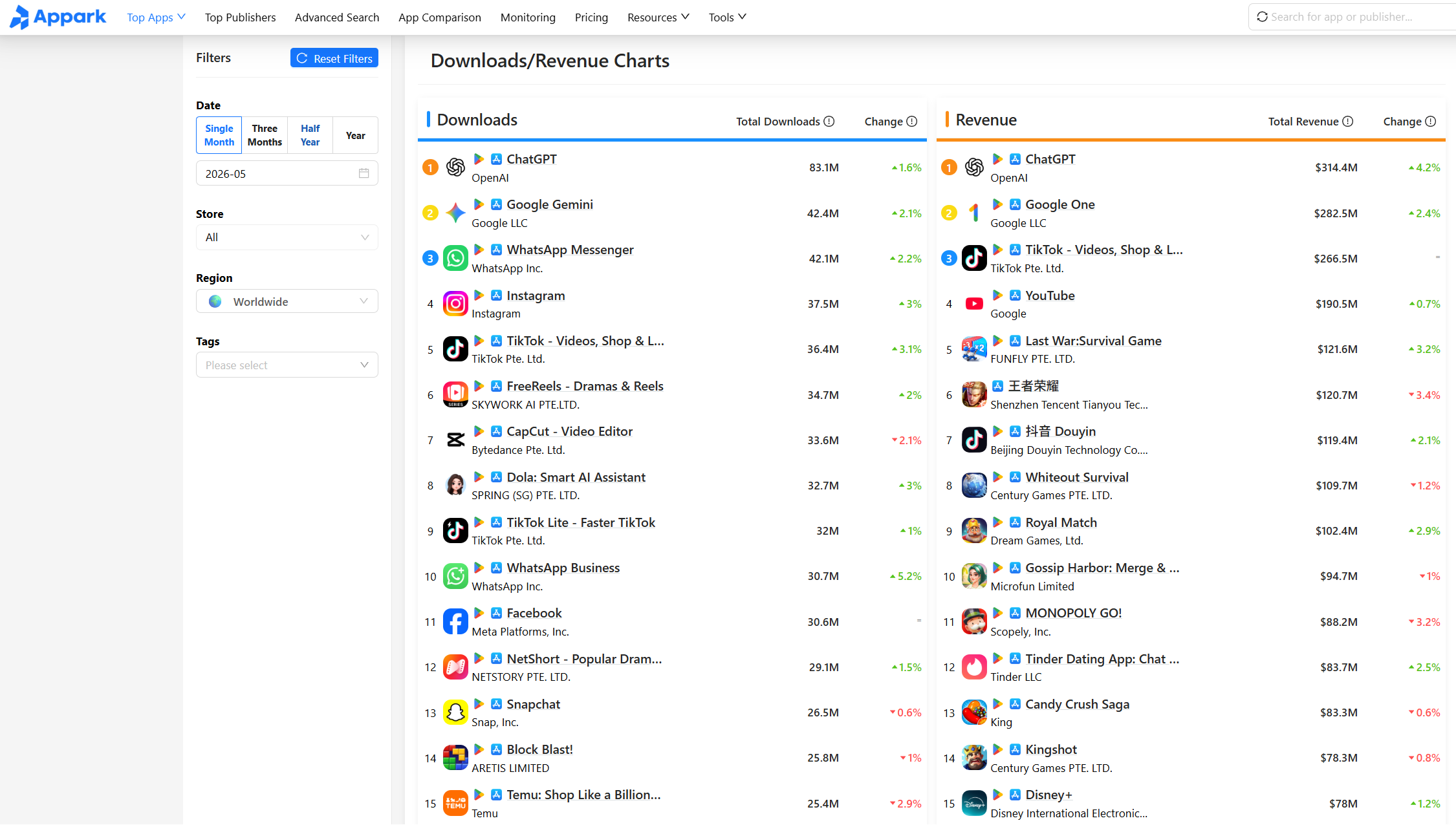
These platforms look at daily download velocities, chart positions, and in-app purchase (IAP) pricing tiers. They also use regional factors to calculate how much users spend in different countries.
Why App Store Revenue Estimates Are Only Estimates
You must understand that App Store revenue estimates are never 100% exact. Apple and Google do not publicly disclose actual app revenue figures, making third-party revenue estimates necessary for market research.
Data platforms cannot see local tax deductions, user refunds, or custom bundle discounts. However, these estimates are incredibly accurate for tracking trends, checking market sizes, and comparing rivals.
How to Estimate App Revenue with Free App Revenue Checker Tools
If you want to estimate how much revenue your competitors generate, you don't need access to their financial statements. By combining top grossing rankings, download trends, and revenue estimation tools, you can build a reliable picture of their commercial performance. Here's a simple workflow you can follow.
Step 1: Find the Top Grossing Apps in Your Category
Open an app market intelligence platform and navigate to the Top Grossing or Revenue Rankings section. Filter the results by platform (App Store or Google Play), country, category, and time period so you're comparing apps in the same market.
Step 2: Identify Your Direct Competitors
Select several apps that target the same audience or solve similar problems. Comparing multiple competitors instead of a single app helps you establish a realistic revenue benchmark for your niche rather than relying on one outlier.
Step 3: Analyze Download and Ranking Trends Together
Revenue estimates are much more meaningful when viewed alongside download rankings. An app with stable downloads and steadily increasing revenue may have a successful subscription model, while an app with high downloads but relatively low revenue may rely on a less effective monetization strategy.
Step 4: Estimate Revenue and Monitor Changes Over Time
Use a free app revenue checker to estimate monthly or yearly revenue based on available market data. Instead of focusing on the exact revenue number, pay attention to long-term trends. Tools that provide app revenue rankings also make it easier to compare multiple competitors, identify fast-growing apps, and spot changes after major updates or marketing campaigns.
Best Free App Revenue Checker for Competitive Research
If you are tired of hidden paywalls, you should check out Appark. It is a completely free, professional mobile app data analytics platform built for small teams.
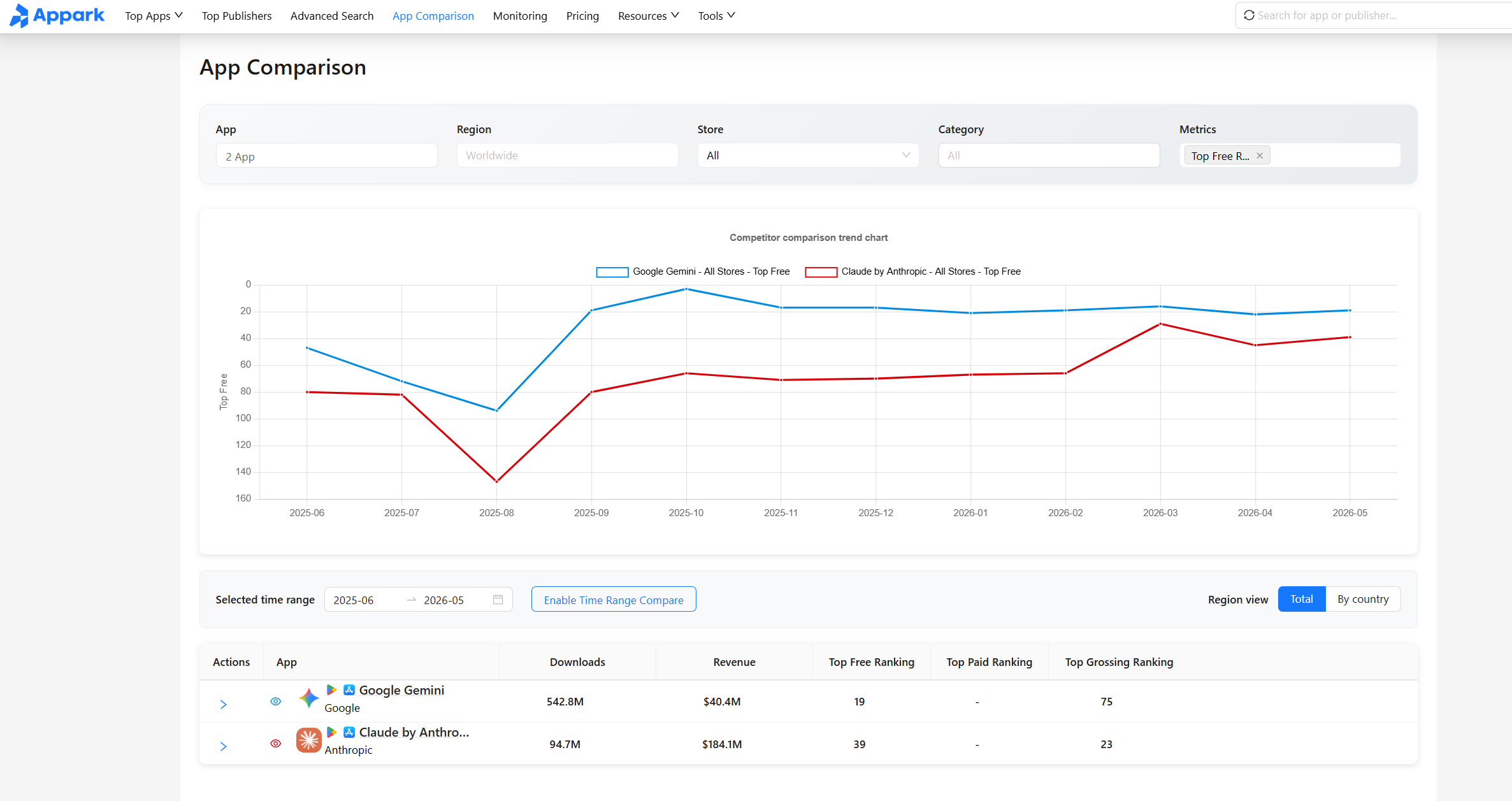
Appark gives you access to vital features like download rankings, revenue rankings, and publisher rankings. It also provides dedicated modules for competitor analysis and live monitoring to help you win your market.
How to Compare Competitors Using Mobile App Revenue Estimates
Compare iOS App Revenue Estimates Across Competitors
When analyzing competitors on the App Store, don't focus on revenue estimates alone. The real value comes from comparing multiple apps within the same category to understand how different monetization strategies perform.
Start by selecting three to five competitors that target a similar audience. Compare their estimated revenue alongside download rankings, update frequency, pricing model, and user ratings. Looking at several apps instead of just one gives you a much clearer picture of what success looks like in your niche.
For example, imagine you're researching productivity apps:
- App A receives around 30,000 downloads per month and generates an estimated $180,000 in monthly revenue.
- App B attracts more than 90,000 downloads, but its estimated monthly revenue is only $80,000.
Although App B has a much larger user base, App A earns significantly more revenue because it relies on recurring subscriptions instead of one-time purchases or advertising. This comparison suggests that users in this category may be willing to pay for premium features if they deliver consistent value.
Rather than copying the most downloaded app, focus on understanding why certain apps monetize more effectively. Revenue estimates help reveal business models that may not be obvious from download numbers alone.
Monitor Revenue Trends with App Revenue Estimates
A single day's revenue estimate doesn't tell the whole story. Markets change constantly, and successful competitive analysis depends on tracking long-term trends instead of isolated data points.
Monitor revenue estimates over several weeks or months to identify meaningful patterns. Sudden increases in estimated revenue often coincide with major feature releases, seasonal promotions, subscription pricing changes, or successful marketing campaigns. Likewise, a gradual decline may indicate stronger competition or decreasing user engagement.
For instance, suppose a competitor's estimated monthly revenue increases by 40% shortly after launching an AI-powered feature. If download rankings also improve during the same period, it's a strong signal that the new functionality is resonating with users rather than being driven by short-term advertising alone.
On the other hand, if downloads rise sharply while revenue remains flat, the app may be attracting users through aggressive acquisition campaigns without improving monetization. These insights can help you decide whether to prioritize new features, pricing adjustments, or user retention in your own product roadmap.
The goal isn't to predict a competitor's exact revenue. Instead, use app revenue estimates to identify trends, benchmark performance, and understand which product and monetization strategies are driving sustainable growth over time.
Common Mistakes When Using App Revenue Estimates
Don't Treat App Revenue Estimates as Exact Revenue
Never use estimated numbers for your internal financial accounting or investor tax reports. These numbers are directional strategic guides, not actual bank account audits.
If an estimator says your rival made $50,000 last month, treat it as a ballpark indicator. Focus on whether that number is going up or down over time.
Combine App Revenue Estimates with Download Rankings
Looking at revenue numbers alone will give you a flawed view of the market. You must always combine revenue data with download rankings to see the true story.
High downloads with low revenue means they have a conversion problem. Conversely, low downloads with high revenue means they have found a highly profitable niche. Note that Appark supports App Store and Google Play data, but not third-party Android app stores.
Choosing the Right App Revenue Estimator for Market Research
Features to Look for in an App Revenue Estimator
The best app revenue estimation tools should provide more than revenue data alone. Besides download and revenue rankings, many product teams also use publisher rankings to understand which companies consistently build successful apps. Analyzing publisher performance can help you identify long-term market leaders, discover emerging publishers, and uncover new opportunities within your target category.
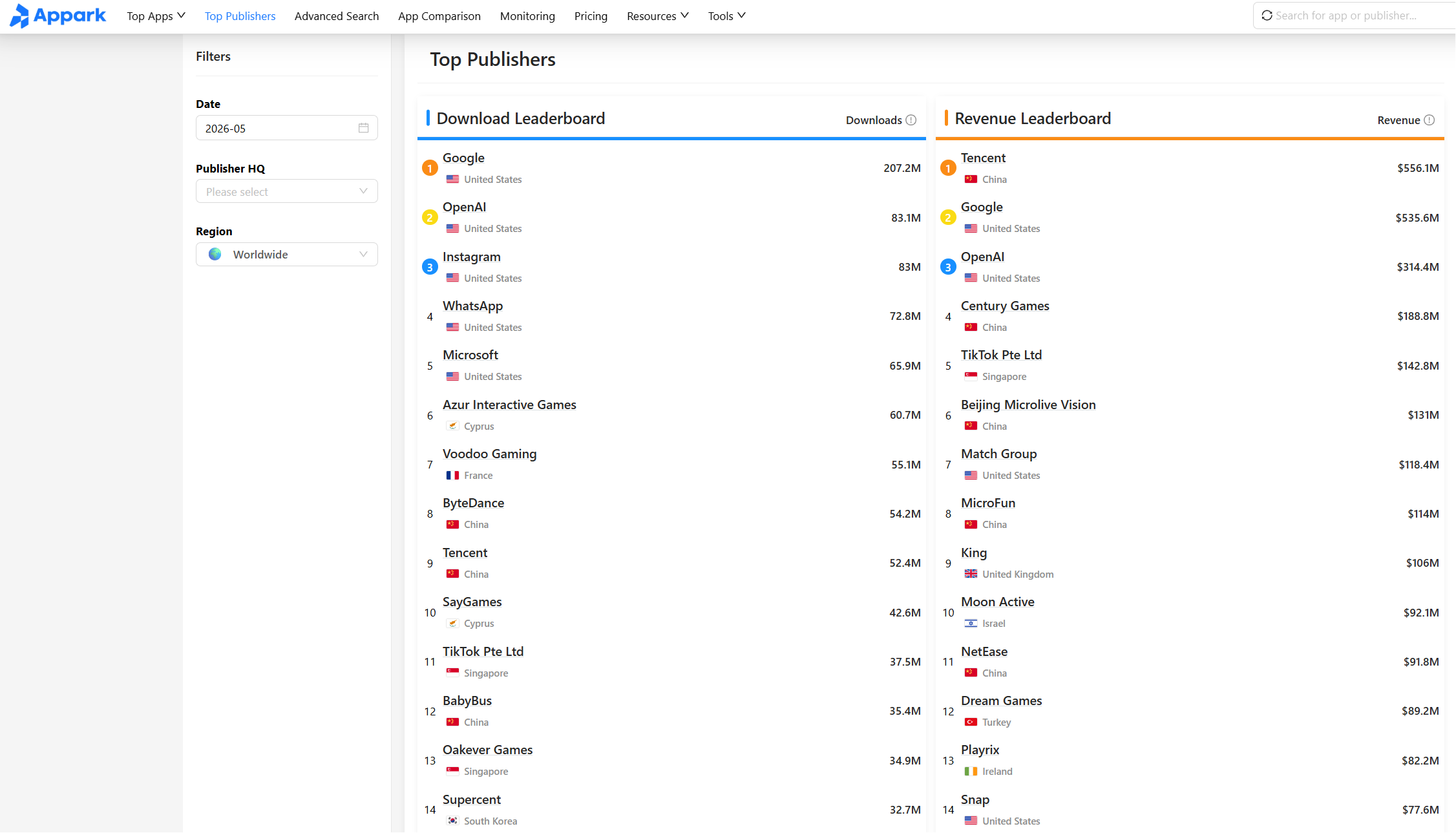
Beyond these insights, the right tool should also offer historical tracking, competitor monitoring, multi-platform coverage, and clear visualizations that make market trends easy to understand. These features allow you to make faster and more informed product decisions without relying on expensive enterprise platforms.
| Feature / Capability | Sensor Tower | AppMagic | AppTweak | Appark |
|---|---|---|---|---|
| App Store Data | Yes | Yes | Yes | Yes |
| Google Play Data | Yes | Yes | Yes | Yes |
| Download Rankings | Yes | Yes | No | Yes |
| Revenue Rankings | Yes | Yes | Limited | Yes |
| Publisher Rankings | Yes | Limited | No | Yes |
| Competitor Analysis | Yes | Yes | Limited | Yes |
| Monitoring | Yes | Yes | Yes | Yes |
| Advertising Intelligence | Yes | No | No | No |
| Starting Price | Paid | Paid | Paid | Free |
Why Free App Store Revenue Estimates Tools Are Enough for Most Teams
Most independent developers and small product teams don't need bloated enterprise features. You don't need to waste money tracking obscure third-party Android stores or heavy ad networks.
You just need to know what works on the main global app stores. Free tools like Appark give you all the core data you need to grow your business safely.
FAQ
How accurate are app revenue estimates?
They are highly reliable for identifying market trends, growth spikes, and relative market shares. While they don't show exact bank deposits, they perfectly reflect an app's commercial trajectory.
Can I check iOS app revenue estimates for free?
Yes, you don't need an expensive subscription to view this data. Platforms like Appark let you check iOS and Google Play data completely free of charge.
What is the difference between an app revenue checker and an app revenue estimator?
People often use these terms interchangeably. A checker usually gives you a quick snapshot of current data, while an estimator uses broader algorithmic models to predict historical and future performance trends.
Can app revenue estimates help identify growing competitors?
Absolutely. By monitoring sudden upward movements in revenue rankings, you can spot rising star competitors before they completely take over your target market.
Stop Guessing and Start Growing Your Mobile App Business Today
App revenue estimates won't tell you the exact income of every competitor, but they are one of the most effective ways to understand market demand, benchmark competitors, and identify profitable opportunities before you start building.
If you're looking for a free way to explore download rankings, revenue rankings, publisher rankings, competitor analysis, and app monitoring across the App Store and Google Play, Appark provides these insights in one place without requiring a paid subscription.
Start your research with real market data and make your next product decision with greater confidence.