

Stop Building Saturated Apps: 7 Unique App Ideas in Niche Markets
Building an app is easier than ever. Finding an opportunity that is actually worth building is not.
A promising idea can look original on paper and still enter a market where established apps already have the users, rankings, and revenue. For independent developers and small teams, that can mean spending months building a product before discovering that demand is already concentrated elsewhere.
A better approach is to start with the market rather than the feature list. Look at which categories are growing, where downloads and revenue are distributed, which publishers are gaining ground, and whether new competitors are breaking into the rankings.
This guide explains how to use those signals to find and validate underserved app niches in 2026. Appark can be used as one part of that research process, with app rankings, estimated downloads and revenue, competitor comparison, publisher data, and ongoing monitoring across the App Store and Google Play.
Why Most “Unique” App Ideas Still Enter Crowded Markets
You come up with an idea, design a sleek interface, and spend three months building it. Then you launch and discover dozens of similar apps already competing for the same users.
The problem is often not the quality of the product. It is that the market was never examined closely enough before development started.
The difference between a new idea and an underserved problem
A new feature idea is not necessarily an underserved opportunity.
- New Idea: “What if we make a habit tracker with pixel-art graphics?” This mainly introduces a different presentation.
- Underserved Problem: “Medical students need a habit tracker that works around complex rotation schedules.” This focuses on a specific user group and workflow.
The second idea may have less obvious competition because it starts with a narrower problem instead of competing for the entire habit-tracking market.
For developers searching for unique app ideas, the goal is not to invent something nobody has ever seen. It is to find a problem that existing products do not serve particularly well.
Why copying successful apps is a risky starting point
Replicating a top-chart app puts you directly against companies that may have larger development teams, stronger distribution, and years of accumulated reviews and users.
That does not mean established categories should be avoided entirely. It means you need a more specific entry point.
Instead of building another general budgeting app, for example, you could investigate a particular financial workflow, audience, or regional use case where existing products have weaker coverage.
What signals indicate a real market gap
Several signals are worth investigating:
- Downloads are distributed across multiple apps rather than concentrated in one or two leaders.
- Mid-ranking apps continue to generate meaningful downloads or revenue.
- Multiple publishers are gaining visibility in the category.
- New apps occasionally break into the rankings.
- Competitors show noticeable differences in performance across countries or subcategories.
None of these signals proves that a niche is attractive on its own. Together, however, they can help narrow down where further research is worthwhile.
How We Found These Opportunities in 2026 Data
Finding an underserved niche requires more than looking at the biggest apps in a category.
The useful question is not simply “Which apps are popular?” It is “How is demand distributed, who is capturing it, and how difficult is it for new players to gain visibility?”
A market research platform such as Appark can help organize these signals across rankings, downloads, revenue, publishers, and competitor performance.
| Research Metric | Saturated Category Signal | Potentially Underserved Signal |
|---|---|---|
| Download Rankings | A few dominant apps control most visible demand | Several mid-tier apps maintain meaningful rankings |
| Revenue Rankings | Revenue is heavily concentrated among category leaders | Multiple smaller apps generate measurable revenue |
| Competitor Comparison | Large performance gap between leaders and everyone else | Several competitors have comparable performance |
| Publisher Rankings | One or two major publishers dominate the category | A wider mix of publishers appears in the rankings |
| Ranking History | The same apps remain at the top for long periods | Rankings show regular movement and new entrants |
| Competitor Monitoring | Established leaders consistently control the market | Smaller or newer apps show sustained momentum |
These signals should be treated as starting points for investigation rather than automatic proof of a market opportunity.
Compare download rankings to measure user demand
Download rankings provide a straightforward way to estimate where user interest is concentrated.
Instead of looking only at the number-one app, examine the distribution further down the ranking. If apps outside the top five or ten continue to attract significant downloads, the category may have more room for differentiated products.
You can also compare the same category across countries. A category that is crowded in one market may have a very different competitive structure elsewhere.
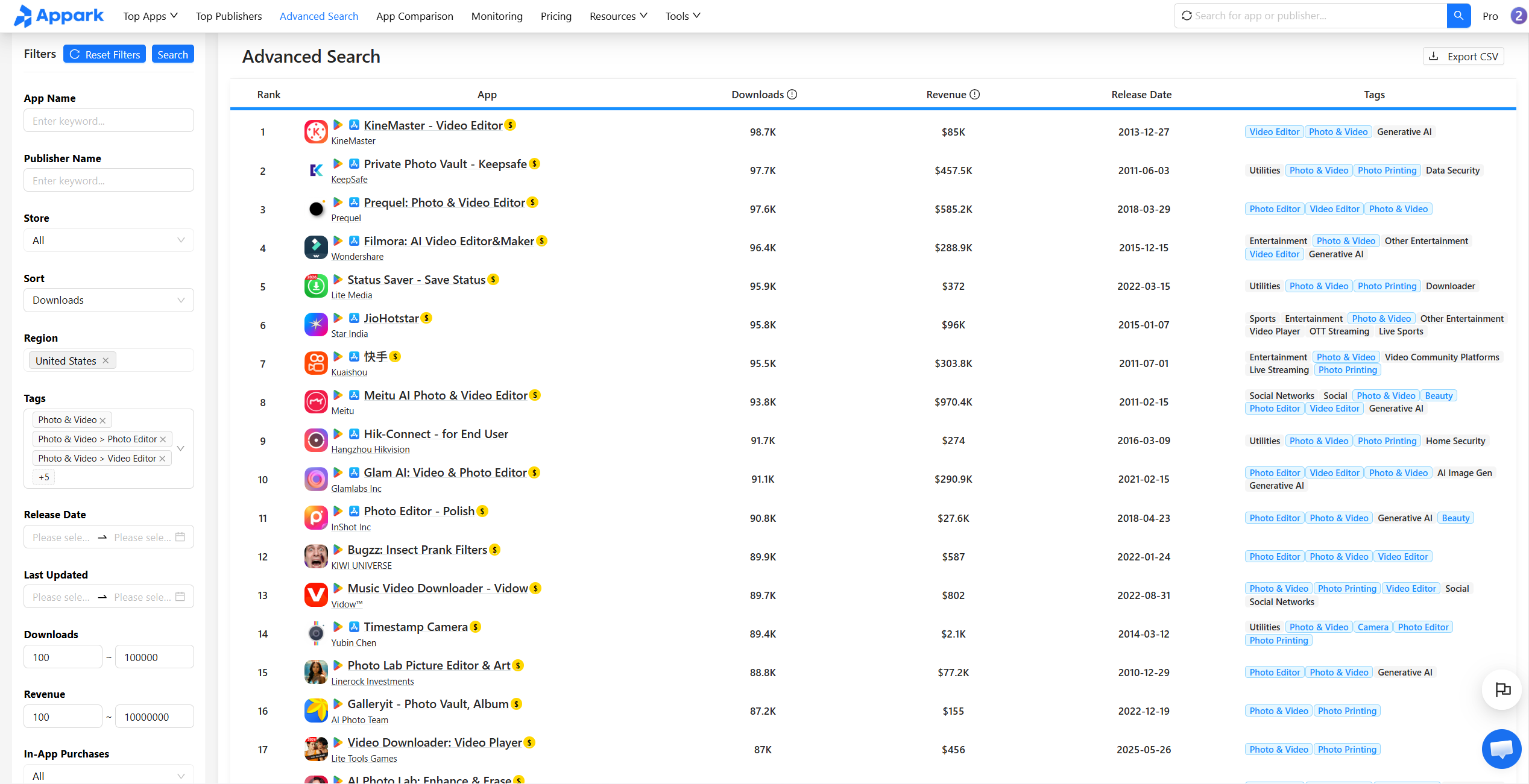
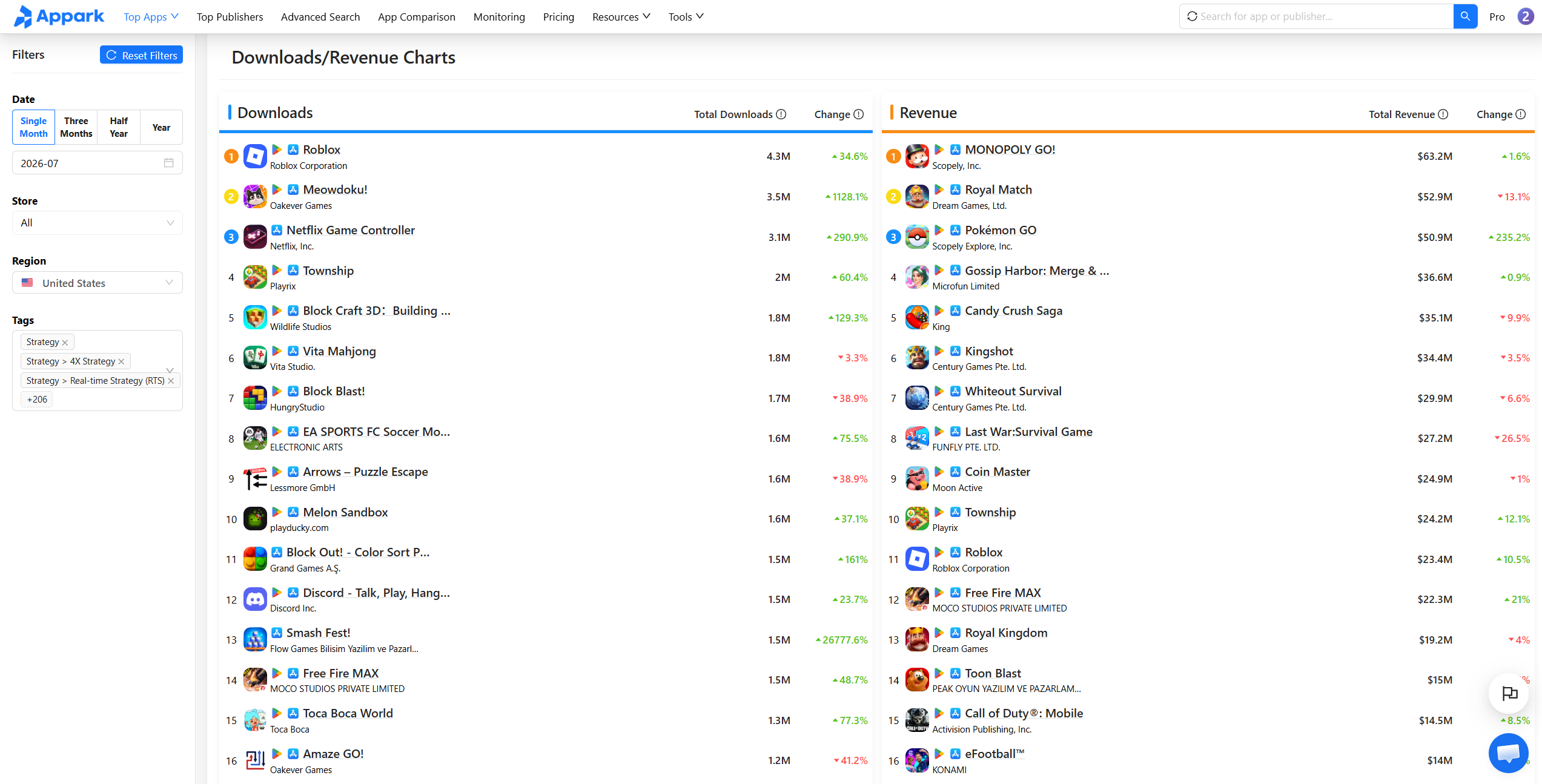
For current download and revenue rankings, Appark's app rankings let you filter app performance by market, category, and store.
Use revenue rankings to identify willingness to pay
Downloads tell you that users are interested. Revenue provides another signal: whether some users are willing to pay for the solution.
A niche does not necessarily need millions of downloads to be commercially interesting. A smaller audience with strong monetization can sometimes be more relevant to an independent developer than a huge audience dominated by free products.
Compare download rankings with top-grossing rankings to identify categories where user interest and monetization behave differently.
Analyze competitors to uncover underserved users
Once you identify a promising category, move from the market level to individual competitors.
Look at several apps rather than only the market leader. Compare their downloads, revenue, rankings, and historical performance. The differences can reveal which products are growing, which are losing momentum, and where the competitive landscape is less concentrated.
User reviews can then add qualitative context. Look for recurring complaints about missing workflows, confusing interfaces, limited use cases, or features that have not kept up with changing user needs.
Track publishers and ranking changes over time
A single ranking snapshot can be misleading.
An app sitting at #30 today may be declining, while another at #80 may have climbed from #300 over the previous few months. Those are very different signals.
Publisher data can also show whether a category is controlled by a handful of companies or whether smaller publishers regularly gain visibility.
Monitoring ranking changes over time helps distinguish temporary spikes from sustained momentum.
7 App Markets Worth Investigating in 2026
The following areas are not guaranteed opportunities. They are examples of how to narrow broad categories into more specific problems worth validating.
1. Specialized student productivity apps
Generic study planners and task managers are crowded. A narrower product can focus on a specific academic path, workflow, or student population.
Examples include tools for veterinary students, bar exam preparation, nursing rotations, flight school training, or university students managing complex course schedules.
The key is to solve a workflow that a general productivity app does not handle particularly well.
2. Tools for overlooked business workflows
Small businesses often rely on spreadsheets, messaging apps, and manual processes for tasks that are too specific for mainstream business software.
Instead of building another general invoice or project-management tool, investigate workflows such as mobile job quoting for local tradespeople, inventory tracking for pop-up retailers, or scheduling tools for specialized service businesses.
The narrower the workflow, the easier it can be to define the target user and the core product value.
3. Hyper-specific personal finance utilities
Personal finance is a large category, but users do not all have the same financial problems.
Potential opportunities can come from specific situations rather than another general budgeting dashboard. Examples include splitting expenses among several roommates, tracking irregular creator income, calculating tax-related estimates for freelancers, or managing shared household costs.
These ideas should still be validated against existing competitors and actual user demand before development.
4. Niche education and learning apps
Large language-learning and education platforms cover broad subjects. Smaller opportunities can exist around highly specific skills.
Consider areas such as native plant identification, specialized music sight-reading, woodworking calculations, technical certifications, or other skills where learners have a clear and recurring need.
The strongest concepts usually have a defined learning outcome rather than simply offering “another educational app.”
5. Local and community-focused services
Some problems are inherently local and therefore less attractive to companies building for a global audience.
Examples include neighborhood tool-sharing, regional trail information, local tide and surf tracking, community event coordination, or location-specific utilities.
The challenge is to determine whether the local audience is large enough to support the intended business model.
6. Hobby-specific utility apps
Hobbyists often have specialized workflows that mainstream productivity apps do not prioritize.
Examples include espresso extraction timers, crochet pattern counters, board-game scoring tools, fishing logs, model-building calculators, or equipment maintenance trackers.
These products can be small in scope while still addressing a problem that users encounter repeatedly.
7. Small but recurring everyday problems
Some of the most practical app ideas solve problems that seem too small for large software companies.
Examples include cleaning duplicate screenshots, managing plant-watering schedules, converting recipe quantities, organizing recurring household tasks, or performing a specific calculation that users repeatedly search for.
The important distinction is frequency. A tiny problem that occurs every day can be more valuable than a complicated problem that users encounter once a year.
How to Turn a Niche Into a Buildable App Idea
Finding an interesting niche is only the first step. The next challenge is reducing it to something small enough to build and test.
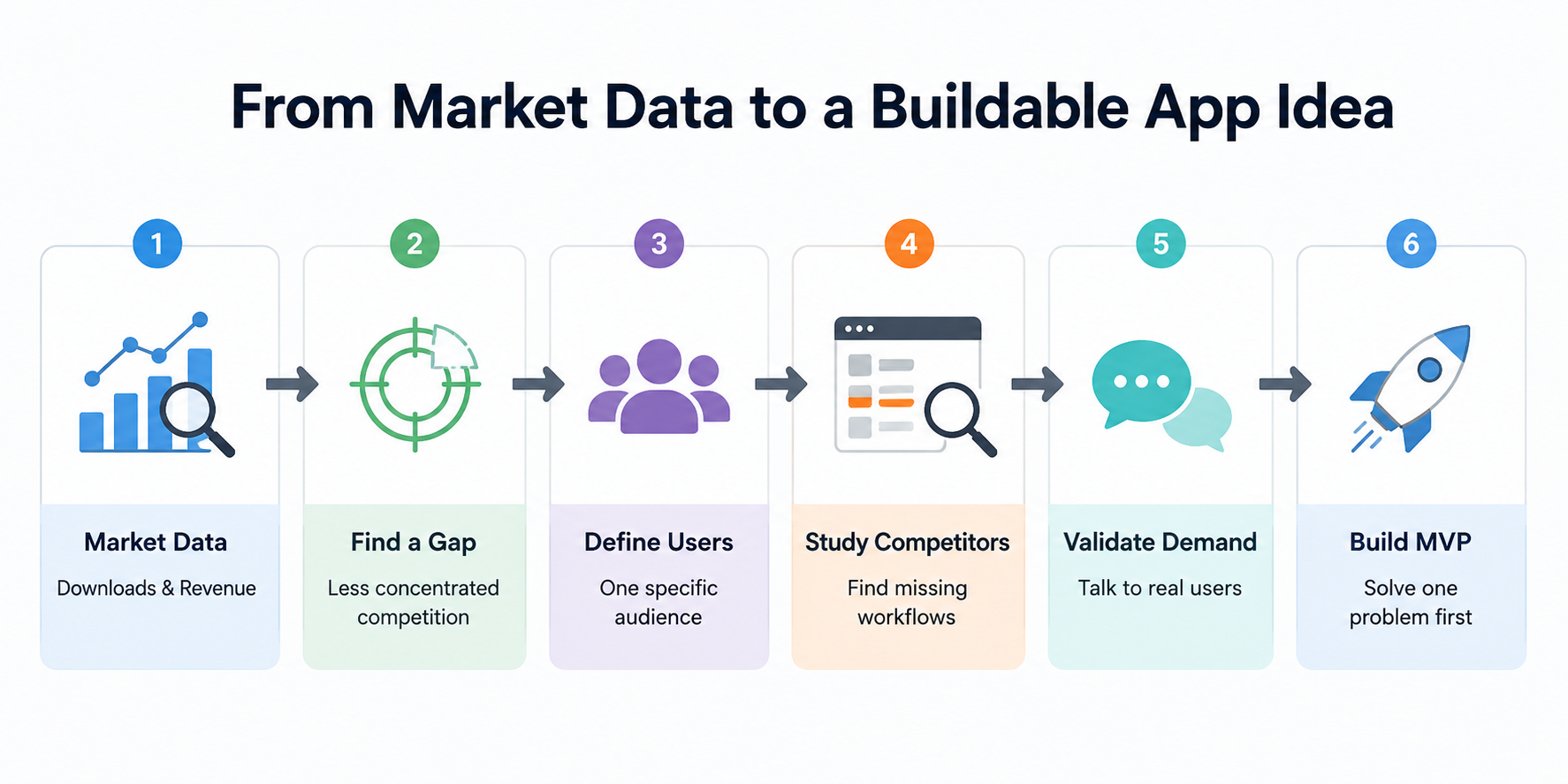
Define one specific user group
Avoid starting with “everyone who needs this.”
Choose one clearly defined group based on profession, education, hobby, location, or lifestyle. A narrower audience makes it easier to understand the workflow and compare existing alternatives.
Identify the recurring problem they already solve
Look for problems people are currently solving with spreadsheets, paper notes, generic apps, messaging tools, or manual calculations.
Existing workarounds are useful signals because they show that users already recognize the problem.
Study what existing apps do poorly
Compare several competitors rather than copying the leader.
Look for recurring complaints, unnecessary complexity, missing workflows, pricing friction, or use cases that appear repeatedly in reviews.
The goal is not to reproduce a competitor with one additional feature. It is to understand where the current solutions stop being useful.
Choose one narrow use case for the MVP
Once you understand the problem, remove everything that is not essential.
A good first version should answer a simple question:
Can this product solve one specific problem noticeably better or more conveniently than the alternatives?
If the answer is unclear, more market research is probably needed before development.
How to Validate Your Idea Before Writing Code
Before opening your code editor, validate both the market and the competitive environment.
Check demand and market momentum
Start by examining download rankings, revenue rankings, and historical movement within the relevant category.
Look for evidence that people are actively using and paying for products in the space. Then check whether demand appears stable, seasonal, or declining.
Compare downloads and revenue across competitors
Do not judge a niche based on downloads alone.
Compare several competitors across both downloads and revenue. This helps distinguish categories with large audiences but weak monetization from smaller markets where users demonstrate stronger willingness to pay.
Look for new entrants and ranking changes
A category becomes more interesting when new apps can gain visibility.
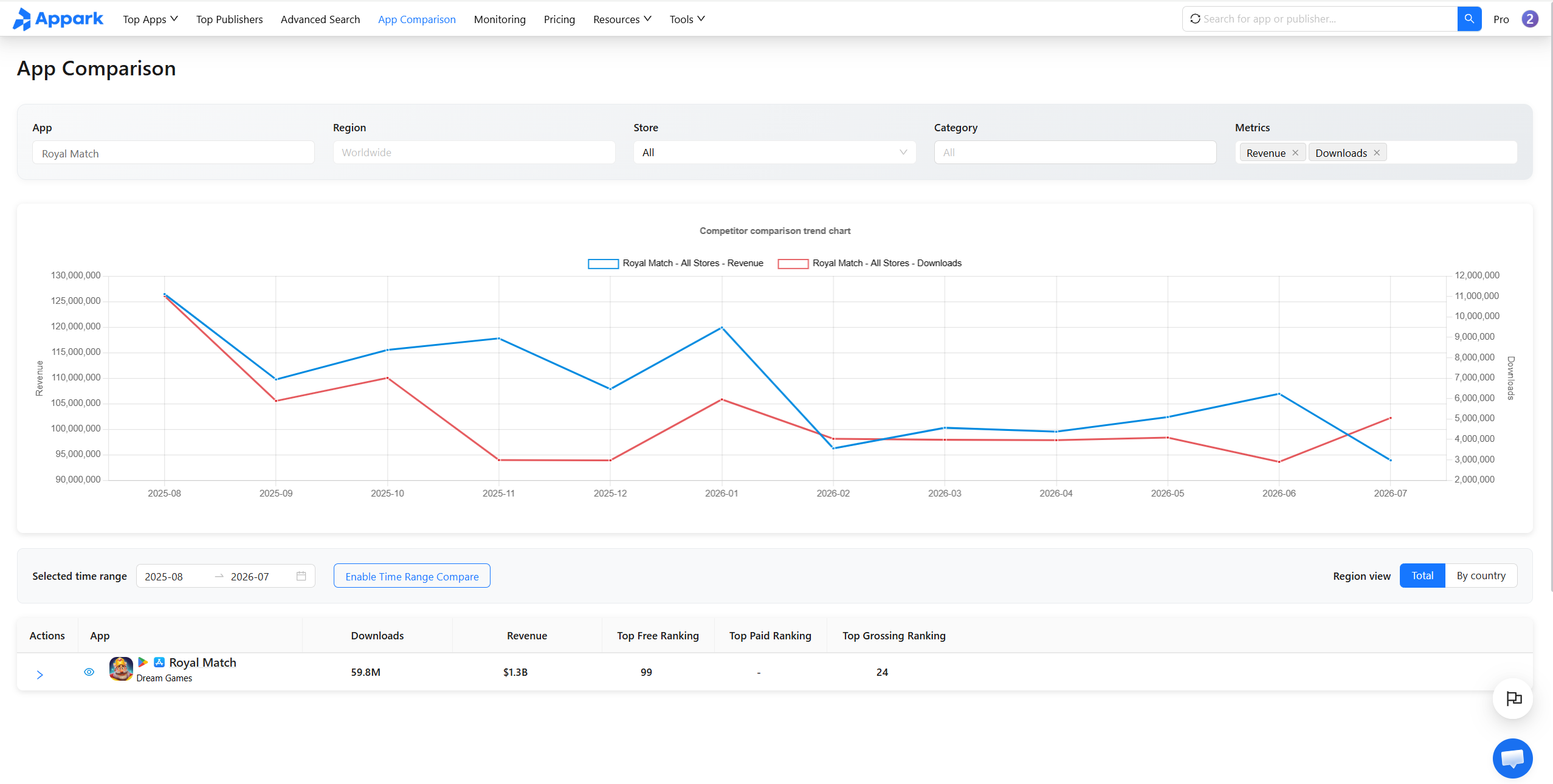
Check historical ranking changes and look for apps that entered the market recently and have continued to improve their position. One successful newcomer does not prove that a market is easy to enter, but repeated examples are worth investigating.
Decide whether the niche is worth pursuing
At this stage, ask four questions:
- Is there evidence of recurring demand?
- Are users already spending money on solutions?
- Is the competitive landscape concentrated or fragmented?
- Can a small team build a meaningful first version without needing a large marketing budget?
If the answers are promising, the next step is not necessarily to build immediately. Talk to potential users, test the problem manually, or create a lightweight prototype first.
Use Appark to Research Your Next App Idea
Appark is most useful here as a research layer rather than as a replacement for customer interviews or product validation.
Find promising categories through download rankings
Start with download rankings to understand which categories and markets have visible demand.
Filter by country, category, and store, then compare the top and mid-ranking apps. Looking beyond the number-one position can reveal markets where demand is distributed across more competitors.
Explore top-grossing apps and revenue trends
Revenue rankings provide another perspective on market attractiveness.
Compare top-grossing apps with their download performance to identify categories where users are not only downloading apps but also paying for them.
Compare competing apps and publishers
Use competitor comparison to put multiple apps side by side and examine their download, revenue, and ranking trends.
This can help answer questions such as:
- Which competitors are growing?
- Is performance concentrated among a few apps?
- Are smaller publishers gaining traction?
- Does one market behave differently from another?
Appark's competitor comparison tool can be used for this part of the research workflow.
Monitor promising apps after choosing a niche
Market research should not stop once you have selected an idea.
Add relevant competitors to a monitoring list and watch ranking movements, updates, ratings, pricing changes, and other changes over time. This can help you understand whether an apparent opportunity is continuing to develop or simply reflects a temporary spike.
Appark's competitor monitoring is designed for ongoing tracking rather than one-time market checks.
FAQ
What makes an app idea truly unique?
A unique app idea does not need to create an entirely new category. It can focus on a specific user group, workflow, or recurring problem that existing apps do not serve particularly well.
The key is finding a clear gap rather than simply adding another feature to an existing product. A narrower audience with a specific unmet need can be more promising than a broad idea competing with dozens of established apps.
Where can I find unique app ideas for students?
Start with specific student workflows rather than generic productivity. Look at problems faced by particular majors, professional programs, schools, or student groups, then examine existing apps to see whether those needs are well served.
Student communities and Reddit discussions can also reveal recurring frustrations. Compare those problems with app rankings and competitor performance to determine whether there is enough demand to explore further.
How do I know if an app niche is too saturated?
Look at how concentrated downloads and revenue are among the leading apps, how stable the rankings are, and whether newer or smaller publishers can gain visibility.
If a few established apps consistently dominate the category, entering with another general-purpose product may be difficult. More fragmented rankings and regular new entrants can indicate room for more specialized solutions.
How can I validate an app idea before development?
Combine market data with direct user research. Compare downloads, revenue, competitors, publishers, and ranking trends, then talk to potential users to confirm that the problem is real and recurring.
You should also check how users currently solve the problem. Existing workarounds and repeated complaints can provide useful evidence that the problem is worth solving before you invest heavily in development.
Should indie developers avoid large app categories?
Not necessarily. Large categories can contain smaller opportunities because strong demand already exists. The challenge is avoiding direct competition with the biggest players.
Instead, focus on a specific audience, workflow, location, or use case where a small team can provide a clear reason to choose its product.
Conclusion
The goal of finding unique app ideas is not to discover an idea that nobody has ever built.
It is to find a market where demand exists but the current solutions leave room for a more focused product.
Start broad with category and ranking data, narrow the market by country and user group, compare downloads with revenue, study competitors and publishers, and then monitor the market over time. Only after those signals look promising should you invest heavily in development.
Tools such as Appark can make the research process faster by bringing rankings, download and revenue estimates, competitor comparison, publisher data, and monitoring into one workflow. The final decision, however, should still come from a combination of market evidence and conversations with real users.
That is a more practical starting point than spending months building an app and checking the market only after launch.