

Mobile App Marketing Strategy: A Data-Backed 2026 Guide
Most articles about mobile app marketing strategy read the same way: a checklist of ASO tips, a paragraph on paid ads, a nod to retention, done. What they rarely show you is what a real market actually looks like while you're building your plan — which apps are climbing the charts this week, which ones are converting installs into real revenue, and how a competitor's download curve moves the moment they change tactics.
This guide walks through the same core framework you'd expect — awareness, acquisition, retention — but grounds every section in live App Store and Google Play data instead of generic advice. Where it's useful, we'll pull examples straight from Appark, a market intelligence platform that tracks rankings, publisher performance, and competitor movement in real time.
What Is a Mobile App Marketing Strategy (And Why Most Apps Fail Without One)
A mobile app marketing strategy is the plan that connects everything you do to get an app discovered, downloaded, and kept — your positioning, your channel mix, your store listing, your retention tactics, and the metrics you use to judge whether any of it is working. Without one, teams tend to default to whatever channel got them their last few hundred installs and keep pouring budget into it long after it stops paying off.
The failure mode is rarely a bad idea. It's usually a missing feedback loop. A team launches, buys some paid traffic, sees installs come in, and never circles back to check whether those users stuck around or whether a competitor quietly repositioned in the same category. A strategy forces that discipline: you set a direction, you measure against real market movement, and you adjust before the budget is gone rather than after.
The Real Cost of Guessing: What App Store Rankings Reveal About Competition in 2026
Here's what the charts looked like on July 3, 2026. Seven weeks earlier, ChatGPT was the app to beat on the Free chart. Today it isn't even No.1 there — Kalshi, a prediction-market trading app, holds the top Free spot for its 4th consecutive day, with ChatGPT pushed to No.2 despite climbing two places since the previous check. On Top Grossing, ChatGPT still leads, and by a wide margin: it's held that No.1 spot for 110 consecutive days, ahead of YouTube and TikTok. Claude by Anthropic doesn't crack the Free top 10 this time, but it does show up at No.9 on Grossing, up one spot.
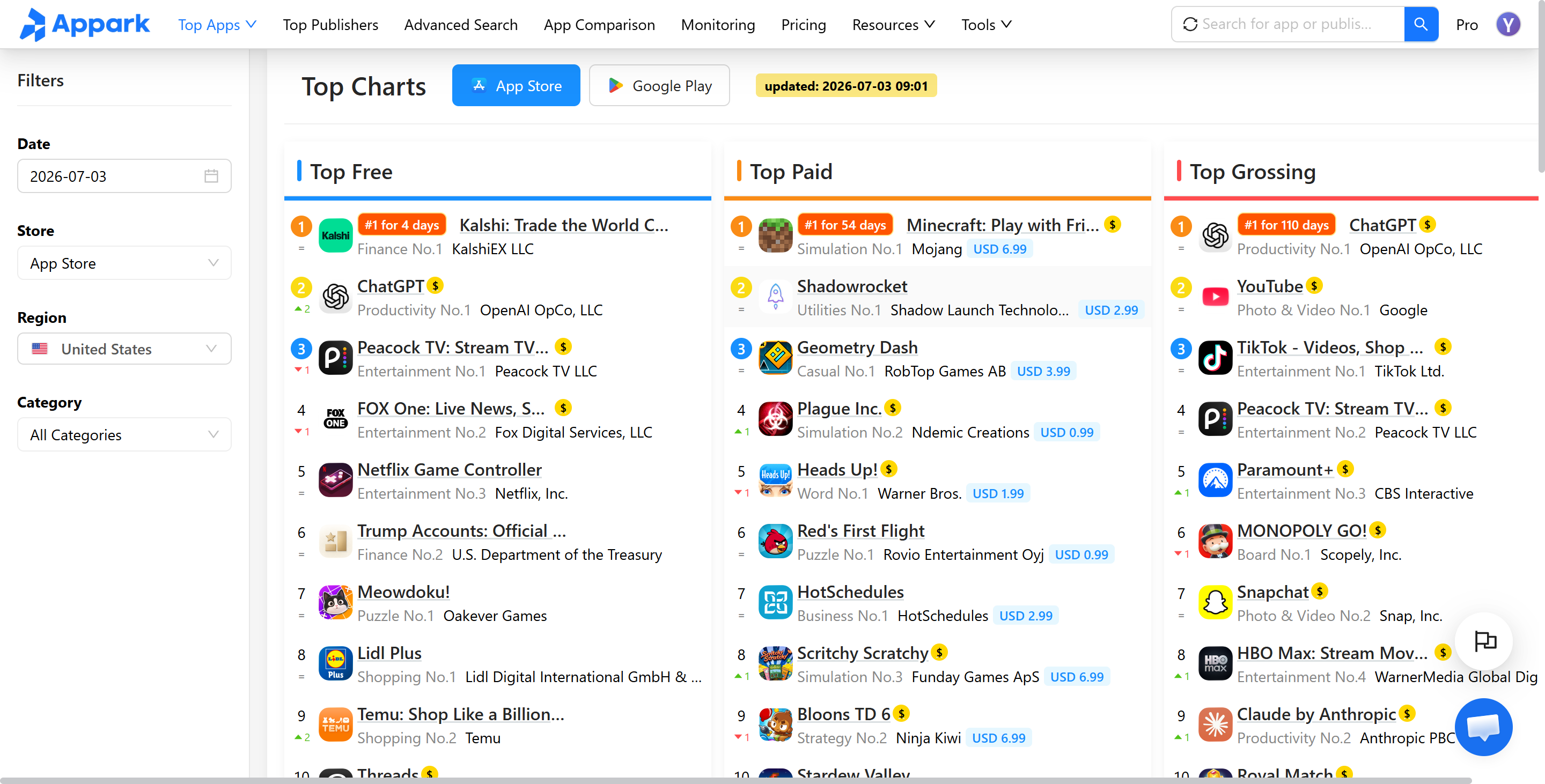
This is the part a static blog post can't give you: charts move daily, sometimes hourly, and the app that looked unbeatable a month ago can lose its own category lead within weeks. Teams that check ranking movement regularly catch these shifts — a finance app suddenly breaking into the general Free top spot, a chat app quietly losing Free-chart ground while its Grossing lead only gets stronger — while they're still actionable, not after a quarter has already been lost to them.
Pre-Launch Groundwork: Strategy Starts Before You Ship
The mistake most first-time app teams make is treating marketing as a post-launch task. By the time an app is live, you've already lost the cheapest window to build an audience. A landing page collecting emails, a short beta with real users giving feedback on onboarding, and a couple of teaser posts on the platforms your target users already use — none of this costs much, but it means you're not starting from zero on day one.
It also gives you something more valuable than early installs: a baseline. If ten people sign up for your beta waitlist and only three finish onboarding, that's a retention problem you can fix before spending a dollar on paid acquisition. Fixing it after you've bought 10,000 installs is a much more expensive lesson.
The Mobile App Marketing Funnel: From Awareness to Retention
Strip away the jargon and every mobile app marketing strategy runs through the same four stages:
- Awareness — people learn your app exists, through search, social, word of mouth, or ads.
- Acquisition — awareness turns into an install, whether that's organic or paid.
- Activation — the user opens the app, gets through onboarding, and reaches a first meaningful action.
- Retention — the user comes back, ideally often enough to become a paying or loyal user.
Most teams over-invest in the first two stages and under-invest in the last two, which is exactly backwards from where the money is made. A $2 install that churns in a day is worse than a $6 install that sticks around for a year. The sections below go through each stage with a specific, checkable tactic rather than a general principle.
App Store Optimization (ASO): The Foundation of Organic App Marketing Strategy
ASO is still the cheapest, most durable channel in any mobile app marketing strategy, because organic search inside the App Store and Google Play accounts for a large share of how people actually find new apps — more than most paid channels combined. The mechanics haven't changed much: title and subtitle keywords, a description that front-loads your value proposition, an App Store product page built around screenshots that communicate the product in three seconds, and a category and tag selection that puts you in front of the right search intent. Both major stores now let you test these elements on real traffic before committing to them — Apple through product page optimization, Android through Google Play's store listing experiments — so you're not just guessing which screenshot order converts better.
What's changed is how much visibility you have into what's working for others. Filter an advanced search to the U.S. App Store's Productivity category and you get a ranked list instead of a guess. ChatGPT sits at No.1 with 3.4M downloads and $98.9M in tracked revenue since its May 2023 release, tagged simply as Utilities. Claude by Anthropic holds No.2 — 2.7M downloads, $16.1M revenue, released May 2024, tagged Generative AI. Google Gemini comes in third: 2.4M downloads, but only $2M in revenue, despite launching later, in November 2024.
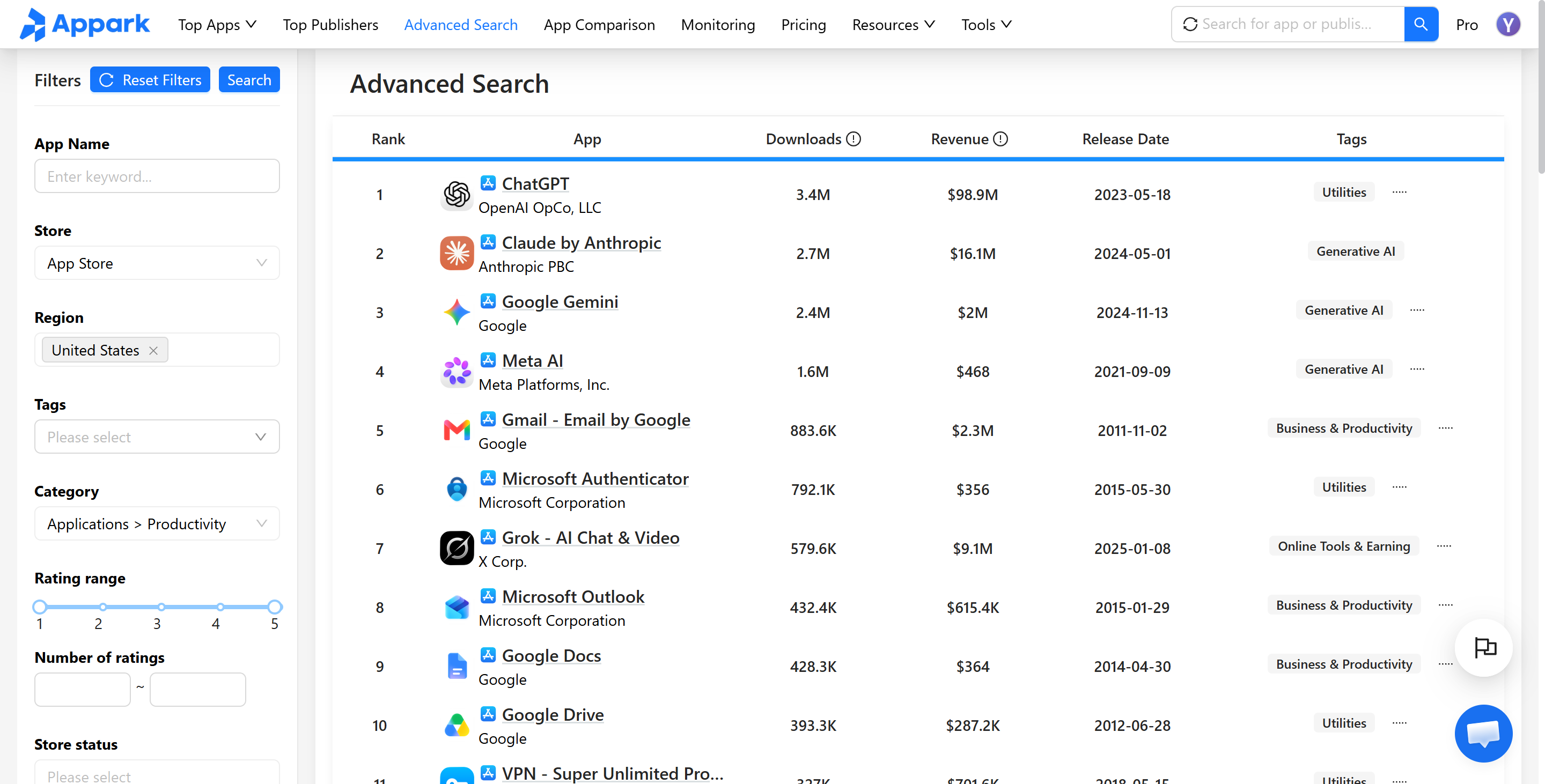
The gap between Claude's and Gemini's numbers is the interesting part: on a similar download base, in the same category, in the same country, Claude has generated roughly eight times more tracked revenue than Gemini. That's not something a generic "do good ASO" checklist tells you — it's a positioning signal. If you're building a competing product in the same category, that's a positioning opportunity, not just a data point.
Competitor Research: How to Benchmark Your App Marketing Strategy Against Market Leaders
Every mobile app marketing strategy guide tells you to "research your competitors." Almost none of them tell you how to do it in a way that produces a decision, rather than a slide with logos on it.
The useful version looks like a trend line, not a snapshot. Comparing Google Gemini against ChatGPT over the twelve months from June 2025 to May 2026 shows Gemini's downloads jumping sharply between August and September 2025 — climbing from around 26 million to 85 million in a single month, briefly closing in on ChatGPT's own download volume — while ChatGPT's revenue line stayed far above Gemini's for the entire period. The totals make the gap concrete: over the full twelve months, Gemini accumulated 542.8M downloads but only $40.4M in revenue, while ChatGPT pulled in 1.1B downloads and $3.3B in revenue — nearly 82 times Gemini's revenue on roughly twice the downloads. That difference shows up in current rankings too: ChatGPT holds No.3 on both the Top Free and Top Grossing charts, while Gemini sits at No.19 Free and No.75 Grossing.
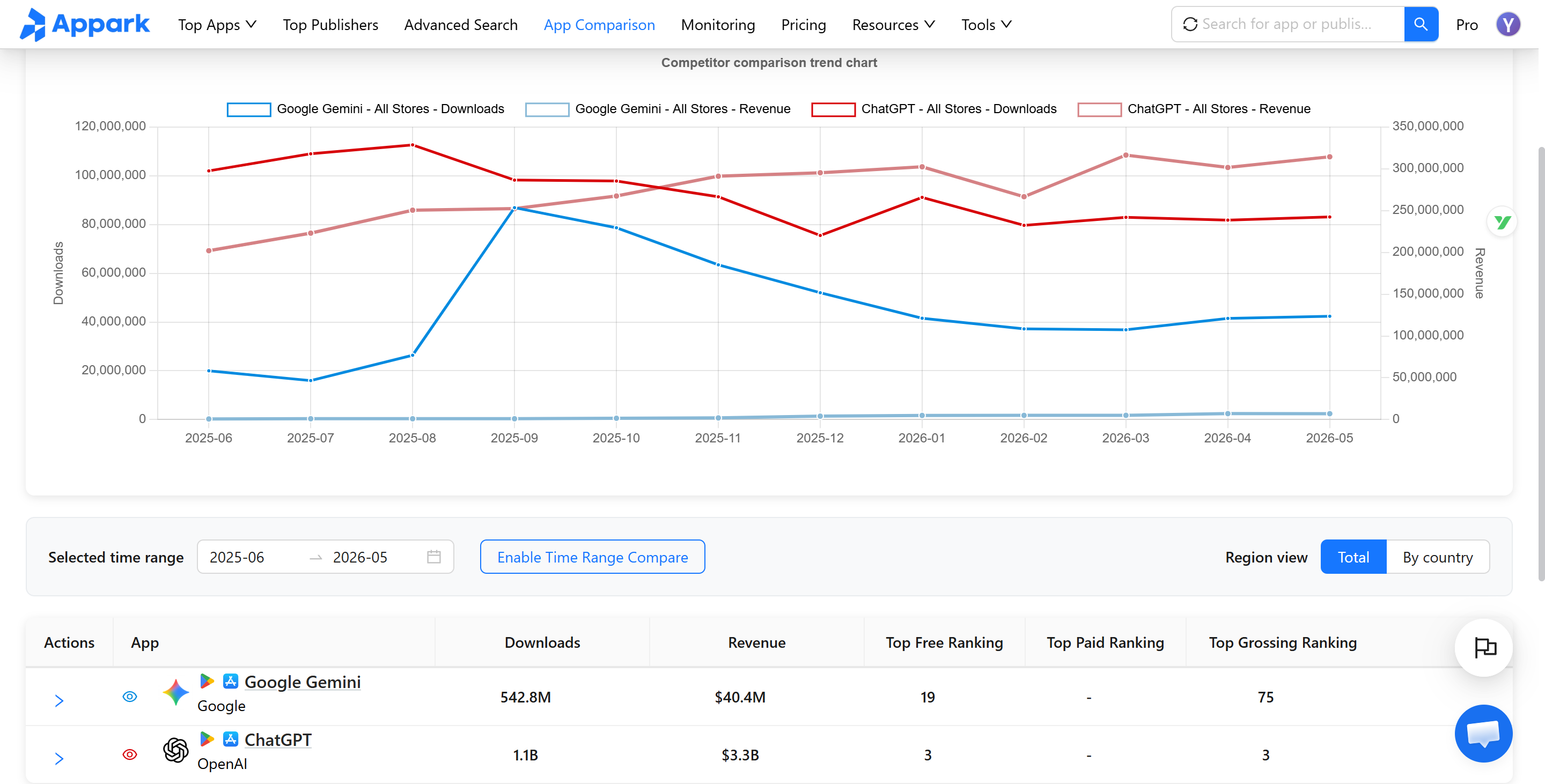
That single chart answers three strategic questions at once: is the competitor growing or shrinking, is that growth translating into revenue, and did a specific event (a launch, a feature update, a pricing change) cause the spike. Build this kind of comparison before you finalize your own acquisition budget — it tells you whether you're entering a category where downloads convert to money, or one where they don't yet.
Paid User Acquisition Channels for Mobile App Marketing in 2026
Paid acquisition still matters, but the channel mix that works depends heavily on who's already winning in your category — and that's visible in worldwide download and revenue charts most teams only check for their own app. Looking at the combined App Store and Google Play numbers for May 2026, ChatGPT led both charts at once: 83.1M downloads (up 1.6% month over month) and $314.4M in revenue (up 4.2%). But the next spots diverge — Google Gemini holds No.2 on downloads with 42.4M, while Google One, not Gemini, takes the No.2 revenue spot at $282.5M. WhatsApp Messenger sits at No.3 on downloads with 42.1M but doesn't crack the revenue top ten at all.
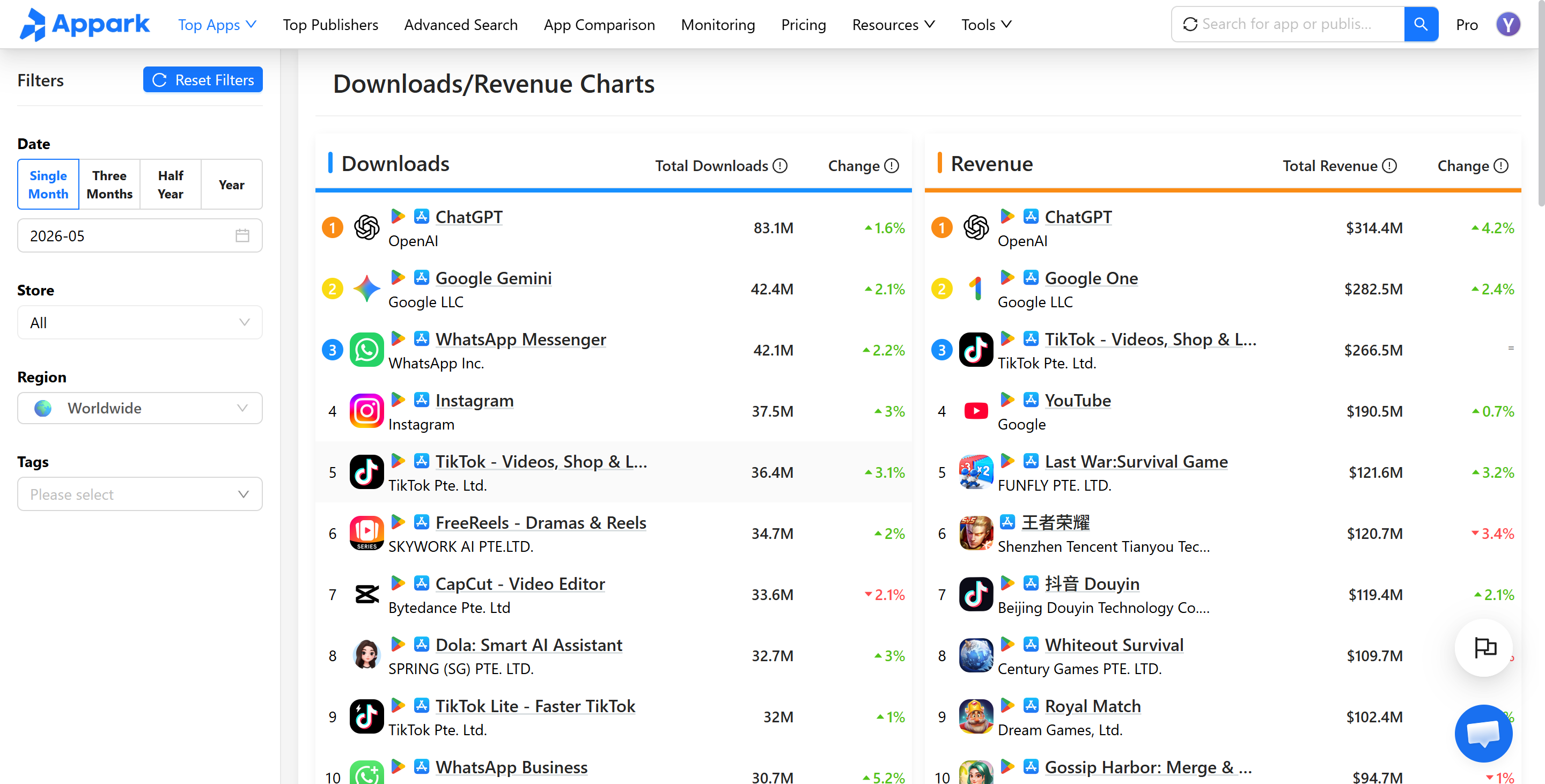
That's the whole story of paid UA strategy in one table: download volume and revenue don't move together. WhatsApp converts almost none of its huge download base into direct in-app revenue, because its business model doesn't depend on it. Meanwhile, Honor of Kings doesn't appear anywhere in the download top ten, yet still pulled in $120.7M — a reminder that a smaller, more monetized user base can outearn a much larger free one. Before you commit budget to Google UAC, Meta Advantage+, or TikTok ads, check whether the apps you're competing against are winning on downloads, revenue, or both, because the channel that works for a free, ad-supported app rarely works the same way for a subscription or IAP-driven product.
In practice, most teams end up running two or three channels at once rather than betting everything on one: a broad-reach channel like Google UAC or Meta for volume, a platform-native channel like TikTok if your audience skews younger, and a smaller test budget on emerging placements like connected TV or OEM store promotion. The point of checking app-level data first isn't to pick a single "winning" channel — it's to avoid spending three months and a real budget finding out a channel doesn't fit your category, when that answer was already visible in how similar apps were performing.
Retention & Engagement Tactics That Maximize App LTV
Acquisition gets an app noticed; retention is what makes the marketing spend worth it. A few tactics consistently move the needle:
- Onboarding that gets to value fast. Cut every step between install and the moment a user experiences the core benefit of your app.
- Push and in-app messaging used sparingly. Over-messaging is the single fastest way to drive uninstalls — segment by behavior, not by "everyone who has the app."
- Feature updates tied to user feedback, not just a release calendar. Users notice when an update solves a problem they actually had.
- Win-back campaigns targeted at users who haven't opened the app in 14–30 days, before they've fully forgotten why they downloaded it.
None of this replaces the fundamentals of a good product, but a mobile app marketing strategy that ignores retention is really just a customer acquisition strategy wearing a different name.
It's worth being blunt about the math here. Industry benchmarks for consumer apps commonly show day-1 retention in the 20–30% range and day-30 retention dropping into the single digits for many categories. That means a strategy that only measures success by install volume is, by definition, measuring the part of the funnel that leaks the fastest. Tracking day-1, day-7, and day-30 retention alongside your install numbers from week one — not after the first quarterly review — is what separates a team that catches a broken onboarding flow early from one that finds out after the ad spend is already gone.
How to Track and Adjust Your App Marketing Strategy in Real Time
The step almost every guide skips: what do you do after launch? A strategy isn't a document you write once — it's a set of decisions you keep making as the market moves.
Setting up a watchlist for your own app and your closest competitors turns this from a monthly guessing exercise into a daily habit. In an active watchlist tracking six apps out of a 50-app limit, a rating-change event on Royal Match (4.1M downloads, $102.4M revenue, last updated May 12) and another on MONOPOLY (28K downloads, $249.3K revenue, updated May 14) both surface next to their current download and revenue figures — with the daily email digest turned on so the update reaches your inbox instead of requiring you to go looking for it.
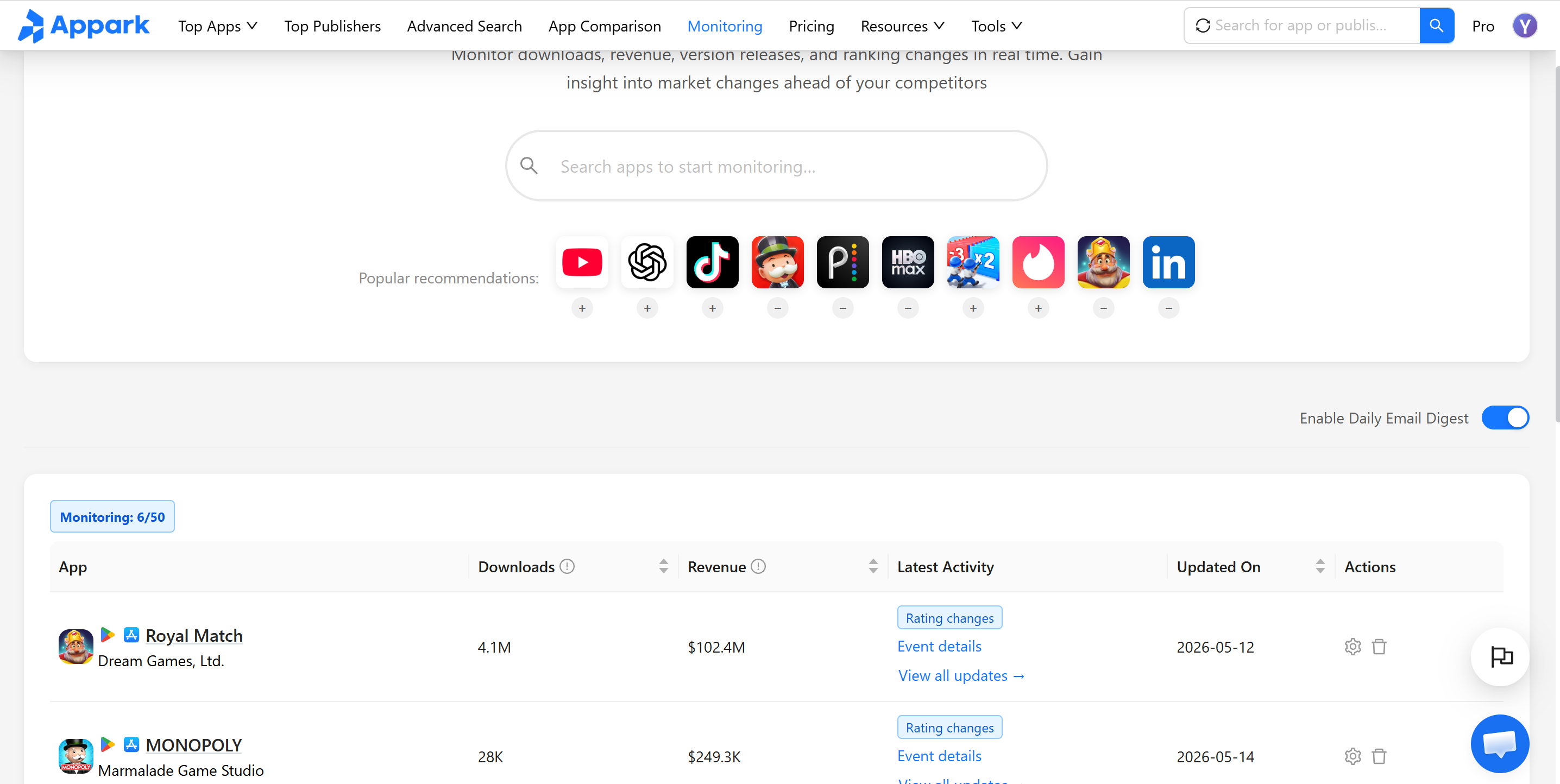
That kind of alert is what lets a team react to a competitor's app update in days instead of finding out a quarter later, in a report, after the impact already happened.
FAQ
How much should I budget for mobile app marketing?
There's no universal number — it depends on category, monetization model, and how competitive your paid channels are. A more useful approach than picking a fixed budget is benchmarking against what competing apps in your category are actually earning, then working backward from a target payback period.
What's the difference between ASO and a broader app marketing strategy?
ASO is one channel — optimizing your store listing for organic discovery. A mobile app marketing strategy is the full plan across ASO, paid acquisition, retention, and measurement. ASO should be the foundation, not the whole plan.
How often should I revisit my app marketing strategy?
Monthly at minimum, weekly if you're in a fast-moving category like AI or social. Rankings and competitor moves that used to shift over a quarter now often shift over weeks.
Do organic or paid channels matter more?
Both, at different stages. Organic (ASO, referrals, content) tends to be cheaper and more durable long-term; paid gets you speed. Most sustainable strategies use paid to jumpstart growth while building organic as the long-term base.
Building a Data-Driven App Marketing Strategy
A mobile app marketing strategy that works in 2026 looks less like a static document and more like an ongoing practice: optimize your store listing, understand exactly where you sit against competitors, pick acquisition channels based on where competing apps in your category actually win, and build retention loops that keep the users you paid to acquire.
The teams that execute this well aren't necessarily spending more — they're checking the market more often and reacting faster. If you want to see how your own app or your closest competitors are actually performing right now, rather than guessing from a six-month-old report, that's exactly the kind of view Appark is built to give you.