


Competitor Analysis Consulting for Mobile Apps: DIY or Hire?
Your app is losing downloads to a competitor. The gap is widening every quarter. You can feel it in the numbers, and you know you need to understand why — fast.
Here's the decision most app teams get wrong: they either write a five-figure check to a consulting firm before they've exhausted free options, or they waste months stumbling through raw data without a framework to act on it.
This guide is my honest take on when competitor analysis consulting is genuinely worth the money, when it isn't, and how to cover 80% of the work yourself before spending a dollar. I've been on both sides — I've written the checks to consulting firms, and I've run competitive intelligence programs with nothing but a browser and free software.
The Real Cost of Competitor Analysis Consulting
If you're evaluating professional competitive analysis for the first time, here's what the market actually charges. These aren't "contact us for a quote" estimates — they're real figures from dozens of engagements I've seen or been part of:
| Engagement Type | Scope | Typical Cost | Timeline |
|---|---|---|---|
| Light-touch audit | Single market, 3–5 competitors | $3,000–$8,000 | 1–2 weeks |
| Standard engagement | Multi-market, 5–10 competitors | $8,000–$25,000 | 3–6 weeks |
| Enterprise deep-dive | Global, full competitive landscape | $25,000–$50,000+ | 6–12 weeks |
Most app teams I talk to balk at those numbers — and they should. The entry-level $3,000–$8,000 range for competitor analysis consulting is hard to justify when that same budget could fund a month of engineering or a meaningful UA experiment. And according to BusinessOfApps, global consumer spending on apps crossed $170 billion in 2025, which means the analytics tools serving that market have never been more capable or affordable.
Before you commit to a retainer, it's worth understanding exactly what those fees cover — because a growing portion of the work can now be handled by free tools, often in real time.
What Competitor Analysis Consulting Actually Delivers
Strip away the discovery calls and the presentation theater, and a consulting engagement covers five things:
- Market mapping — who you're actually competing against, including apps you didn't know existed
- Feature benchmarking — a side-by-side breakdown of what each product does
- Pricing analysis — subscription tiers, IAP strategies, where the revenue comes from
- ASO audit — keyword rankings, store visibility, listing conversion
- Strategic recommendations — what to do about all of the above, in order of priority
The first four are now largely automated. Modern app competitive intelligence tools handle ranking trends, download estimates, review sentiment, and update tracking on autopilot. The fifth — strategic interpretation, connecting dots, making judgment calls — is where the consulting fee actually goes.
So the real question becomes: can you cover 80% yourself with the right tool stack, and only pay for the 20% that requires experienced strategic judgment?
When Does Competitor Analysis Consulting Justify the Cost?
Here's a quick framework. Find your situation on the left:
| Your Situation | Best Approach |
|---|---|
| Solo founder, under $500/month marketing budget | Free tools only — appark.ai for tracking, App Store reviews for sentiment |
| Small team, need ongoing competitive monitoring | Free tools for daily tracking + occasional consultant Q&A when something unusual surfaces |
| Launching into a new app category | Competitor analysis consulting for the initial landscape map, then tools for ongoing tracking |
| Enterprise market entry ($1M+ investment at stake) | Full professional engagement — the stakes justify the cost |
| Weekly competitive monitoring | Free tools only. Paying consulting rates for recurring monitoring is overkill. |
The pattern is straightforward: hire a consultant when the stakes are genuinely high — a major launch, a pricing pivot, a new market entry. For everything else, automated tools win on speed, cost, and frequency.
DIY App Competitor Analysis: A 5-Step Framework
Whether you run this yourself or hand it to a competitor analysis consulting firm as a project brief, this framework consistently turns raw data into decisions. I've used Appark across multiple app categories.
Step 1: Map Your Competitive Universe
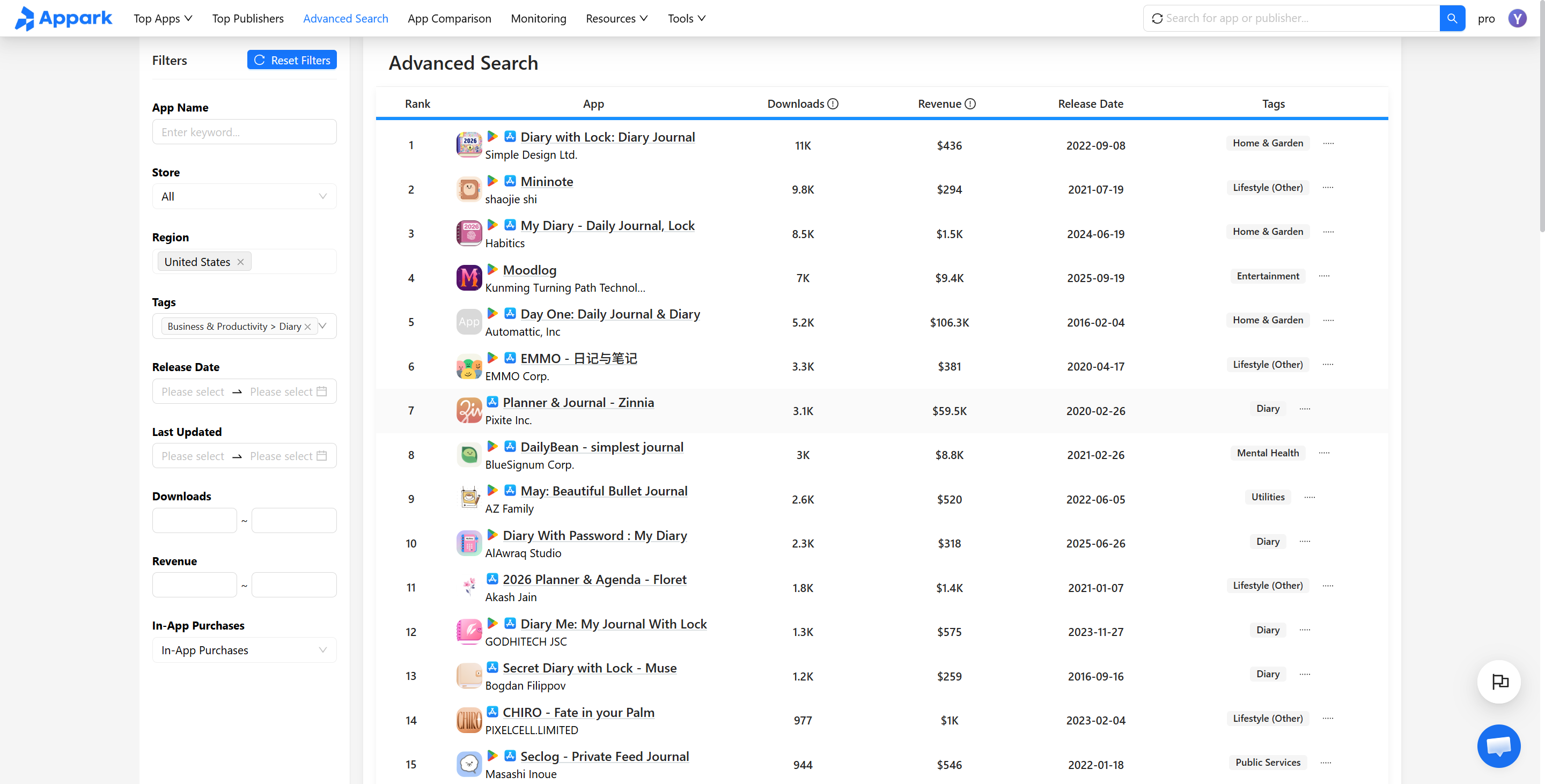
Open Advanced Search. Filter by category, country, and monetization model. Pull the top 20 results. Classify each app: direct rival, indirect competitor, emerging threat.
One rule worth following: if an app appears in 3+ users' "similar apps" lists, it earns a seat at the table — regardless of how it's categorized in the store.
Step 2: Benchmark the Signals That Move the Needle
Track five things — not twenty.
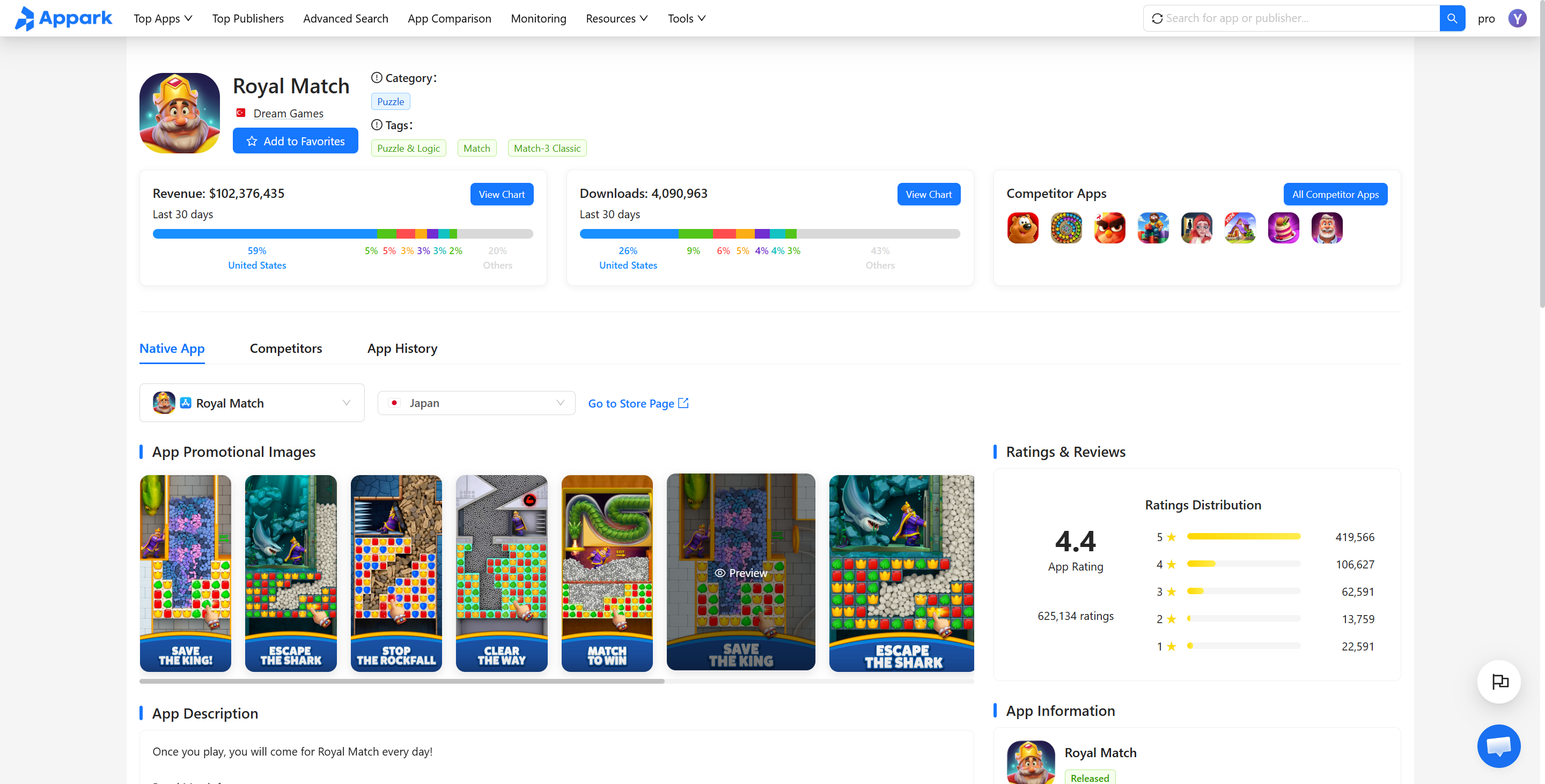
Ranking trends. Download estimates. Revenue signals. Update frequency. Review sentiment.
Appark's Top Charts and Monitoring features handle all of this automatically. Set up alerts and stop checking manually. Your time is better spent on Step 5.
Step 3: Run a Feature Gap Analysis
Build a four-column spreadsheet: Feature | Your App | Competitor A | Competitor B.
Mark each cell: ✅ has it, ⚠️ has it but it's clunky, ❌ missing entirely.
The pattern will surface two things: what competitors are exploiting that you're not, and what whitespace you can move into before they do.
Step 4: Map Pricing and Monetization
Document every subscription tier, IAP strategy, and ad model across your top 5 competitors. Plot them on a price-versus-features grid. Where's the open space? If four apps are clustered at $4.99 a month and $14.99 sits empty, that's a signal worth acting on.
Step 5: Turn Insights Into a 90-Day Action Plan
Data without action is expensive trivia. For each insight, define three things: the specific action, the person who owns it, and the deadline.
If you're working with a consulting firm, this framework gives you a shared language going in. You'll know what to ask for instead of nodding through a deck. If you're doing it solo, this is your operating manual.
Want to go deeper on ASO benchmarking and review mining? Read our step-by-step guide to mobile app competitor analysis for advanced tactics.
How AI Is Reshaping Mobile App Competitive Intelligence
The competitor analysis consulting industry is changing faster than most firms inside it will admit. Four structural shifts are rewriting the economics right now:
Automated monitoring has replaced the manual weekly check-in. What once took a junior analyst two full days now runs in the background, continuously, at no marginal cost. Tools like appark.ai surface ranking changes and competitor updates the moment they happen.
AI-powered review analysis can process 10,000 reviews in seconds. Sentiment patterns that once required hand-tagging every comment are now a single dashboard view. The output is faster and more consistent than human coding.
Real-time ranking alerts have made the quarterly PDF obsolete. By the time a consultant formats a chart, the underlying data has already shifted. Teams running live dashboards catch competitive moves weeks before a traditional report would surface them.
Interactive dashboards have replaced static slide decks as the primary deliverable. Clients expect to log in and see live data, not an archived snapshot that was accurate three weeks ago.
None of this means competitor analysis consulting is dying. But the economics have changed permanently. The best engagements today start with data that both sides can see in a shared dashboard. The consultant's job shifts from data collection to interpretation — from reporting what happened to deciding what to do about it.
For app teams, that changes the math entirely. You can run a consulting-grade mobile app competitive intelligence program with free tools, then bring in a specialist when you hit a decision that requires real strategic expertise.
Real App Competitor Analysis in Action: Fintech Case Study
Here's what this looks like with real apps and real data.
We used Appark.ai to monitor the top 5 US mobile banking apps through Q2 2026, pulling daily rankings, revenue signals, update cadence, and review sentiment. Three findings drove immediate roadmap changes:
Pricing consolidation created an uncontested tier. Four out of five apps converged on the $4.99–$9.99 monthly band over a six-month window. The $15+ premium tier was nearly empty — five companies fighting for the same middle-market customer while a higher-margin segment sat open.
Data pulled from appark.ai's pricing monitoring dashboard, Q1–Q2 2026.
AI features generated backlash, not retention. Every app in the set shipped AI-powered budgeting or spending analysis during the period. User reviews told a different story: the most common complaints were "too complicated," "feels gimmicky," and "I just want to check my balance." The feature race was real, and so was the user fatigue.
A high-growth regional market was completely ignored. All five apps over-indexed on the US. Meanwhile, Southeast Asian mobile banking downloads grew 41% year-over-year, per Data.ai's State of Mobile 2026 report. No team in the set was tracking the fastest-growing region in the category.
These are the kinds of insights that change roadmaps and reallocate budgets. A year ago, surfacing them would have required a consulting engagement. Today, the data is accessible to any team with a browser and the right tools. The tool doesn't replace the strategist — it removes the busywork standing between you and the insight.
FAQ: Common Questions About Hiring a Competitive Analyst
How much does competitor analysis consulting cost?
Between $3,000 and $50,000+, depending on scope, market coverage, and depth. For app-specific work, the typical sweet spot is $8,000–$15,000 for a 2–4 week engagement covering 5–10 competitors.
Can I do mobile app competitor analysis myself without a consultant?
Yes. Tools like Appark.ai handle monitoring, ranking tracking, and review analysis continuously and for free. Reserve the consulting budget for strategic calls — the decisions where getting it wrong costs more than the engagement fee.
How often should I update my competitor analysis?
Weekly for automated tracking — rankings and reviews shift fast, and you don't want to be the last to notice a competitor's price drop or feature launch. Quarterly for a full strategic review, which is roughly how long it takes major product changes to play out in the market. A full consulting engagement once or twice a year, timed around launches or funding rounds.
What's the difference between ASO analysis and competitor analysis consulting?
ASO analysis is narrow: keyword rankings, store listing conversion, search visibility within the app stores. Competitor analysis consulting covers the full competitive picture — product strategy, pricing architecture, market positioning, user sentiment, and dynamics that extend well beyond the store listing.
What's the difference between app competitive intelligence and competitor analysis consulting?
App competitive intelligence is the ongoing process of tracking what competitors are doing — rankings, updates, reviews, pricing. Competitor analysis consulting is a scoped engagement that synthesizes that intelligence into a strategic recommendation. One is continuous monitoring; the other is expert interpretation of what the monitoring reveals.
Your competitors are being tracked right now. The question is whether you're the one doing it.
The teams that consistently win at this run a layered setup: free tools for ongoing monitoring, in-house analysis for day-to-day moves, and targeted consulting when they hit a genuine strategic fork. They don't pay consulting rates for work that automation handles better.
Sign up for Appark.ai — it's free, and it covers the first 80% of what a consulting firm would charge you for. When you hit the 20% that needs an experienced brain, you'll know exactly what to ask for.