


Mobile App Development Trends 2026: Build for Growth & Retention
You know the feeling. You stay up for three consecutive nights to push a massive new update live, grab a coffee, and refresh your console dashboard—only to watch your hard work sink straight into oblivion. Days pass, and your daily downloads are still stuck in the double digits, while your retention charts look like a ski slope.
Let’s be honest: the era of "build it and they will come" is officially dead. Shipping an app to the App Store or Google Play used to guarantee at least a baseline stream of organic traffic, but in 2026, relying on that old playbook is a fast track to burning through your remaining runway.
The macro numbers paint an incredibly deceptive picture. Sure, the global mobile application market size is projected to touch an eye-popping $378 billion this year, and users are on track to hit 292 billion worldwide downloads. But behind those massive tech reports lies a brutal reality that most industry observers choose to ignore: 90% of mobile apps are opened exactly once and then completely forgotten, while over 95% of users churn entirely within the first 30 days, according to Business of Apps.
If you want your app to stay in that elite, profitable 5% instead of becoming another statistic in the 90% app graveyard, you must align your product pipeline with where the market is moving right now. Let’s separate the signal from the noise and look at the defining mobile app development trends in 2026 that will dictate which products scale and which ones disappear.
Top Mobile App Development Trends in 2026
To understand why so many products fail to survive past their first month, you have to look at current mobile app development trends and how rapidly the definition of a standard application has changed... If your current product roadmap relies on static, cloud-heavy frameworks, your engineering pipeline is already running behind.
AI-First Development
We have officially entered the era of GenAI-native architecture, moving aggressively away from traditional, click-heavy interfaces.
How AI is Transforming Mobile Apps:
- Agentic AI Execution: Acts as an autonomous agent that natively grasps user behavior, moving past simple API calls or basic text summary.
- Dynamic Layout Rearrangement: Adjusts user interfaces on the fly and surfaces specific features based on real-time conversational inputs.
- Automated Multi-Step Workflows: Executes complex backend processes without forcing users to navigate through traditional sub-menus.
AI-driven agentic workflows improve customer experience and establish the new standard for modern user retention.
Immersive AR and Spatial Computing
Augmented Reality (AR) is evolving into spatial computing, reshaping how users interact with the physical world across retail, education, and gaming sectors.
- Virtual Try-Ons & 3D Previews: Allows consumers to place and inspect digital assets in their living spaces naturally.
- Multimodal Spatial UX: Combines eye-tracking and gesture capture via shared SDKs to measure live attention vectors.
- Spatial Computing Wins Presence: Transitions interfaces from traditional screen pixels into full physical presence, boosting buying confidence.
Voice Commerce and Conversational Transactions
Voice has moved past basic search queries; it is rapidly transforming into a direct portal for financial toolsets and instant checkouts.
- Hands-Free Transactions: Enables secure, voice-authenticated payments and seamless multi-step order placement.
- Conversational AI Checkout: Replaces endless drop-down sub-menus with native, conversational onboarding and booking flows.
- Frictionless Conversion Lift: Removes traditional transaction hurdles, drastically scaling customer lifetime value (LTV) natively.
Maturation of Cross-Platform Frameworks
The legacy debate of "Native vs. Cross-Platform" has effectively been settled, making unified frameworks the default configuration for scaling teams.
Benefits of Modern Cross-Platform Development:
- Single Core Codebase: Handles all heavy lifting—from state management and data modeling to API integrations—across both iOS and Android.
- Lean Platform Shells: Isolates platform-specific repositories to handle native UI elements and fluid native animations seamlessly.
- Synchronized Release Sprints: Runs automated testing once and deploys to both application stores simultaneously with zero last-minute chaos.
Unified software engineering slashes your product's time-to-market by weeks and cuts ongoing maintenance overhead effectively in half.
On-Device AI and Edge Computing
Relying entirely on cloud inference introduces heavy network latency and introduces prohibitive server costs that rapidly destroy operating margins.
Advantages of Edge AI Integration:
- Local Workspace Inference: Runs complex machine learning models directly via advanced mobile neural engines and optimized local weights.
- Zero Network Latency: Eliminates the latency of cloud server round-trips, delivering real-time translation and hyper-personalized UI adjustments instantly.
- Asynchronous Cloud Syncing: Executes real-time workloads on the user's phone locally while pushing long-term telemetry data back quietly.
Local processing completely cuts out expensive API token costs while unlocking a powerful marketing pitch: "Your data never leaves your device."
Global Rise of Super Apps
Monolithic, single-purpose applications are steadily losing real estate on user screens as modern tech pivots toward unified digital ecosystems.
The Backbone of Super App Ecosystems:
- Decoupled Micro-Frontends: Allows third-party white-label partners or internal product lanes to slot independent features seamlessly into the main app shell.
- Unified Payment Infrastructure: Eliminates user onboarding friction by maintaining absolute control over cross-domain transactions natively.
- Decentralized API Integrations: Stitches together historically disconnected services—merging messaging, social feeds, and financial toolsets smoothly.
Transitioning from a standalone product into an interconnected ecosystem is the ultimate weapon to scale customer lifetime value (LTV) natively.
Why Tracking Mobile App Development Trends Matters
Ignoring macro shifts means steering your software straight into a structural brick wall. Tracking current mobile app development trends is non-negotiable if you want to protect your product roadmap from expensive operational oversights:
- Navigating Feature Graveyards: Prevents burning limited runway on flawless solutions to problems nobody actually has.
- Capturing Arbitrage Windows: Ensures day-to-day visibility to notice competitor updates before customer acquisition costs (CAC) skyrocket.
- Fixing Pricing Triggers: Avoids blind monetization by leveraging category-specific trial-to-paid benchmarks instead of guessing subscriptions.
How to Build with Mobile App Development Trends in 2026
To survive the brutal 95% churn rate of the current mobile ecosystem, you must stop operating on gut feeling. You need to transition into a cold, data-driven framework. For years, massive enterprise tools like Sensor Tower and AppMagic held a monopoly over mobile intelligence, locking smaller development teams out with prohibitive pricing tiers.
But in 2026, the game has changed. The emergence of Appark has democratized mobile product management, providing an agile, highly intuitive platform to discover market arbitrage, dissect direct competitors, and automate your long-term market monitoring.
Here is the exact, 3-step guidelines you can deploy using Appark to ensure your product lanes align perfectly with modern Mobile App Development Trends.
Step 1: Target Specific Sub-Genre Competitors
Before you write a single line of cross-platform code, you must validate whether your target category is expanding or contracting. You need to look beneath the generic App Store top charts to find hyper-specific growth signals.
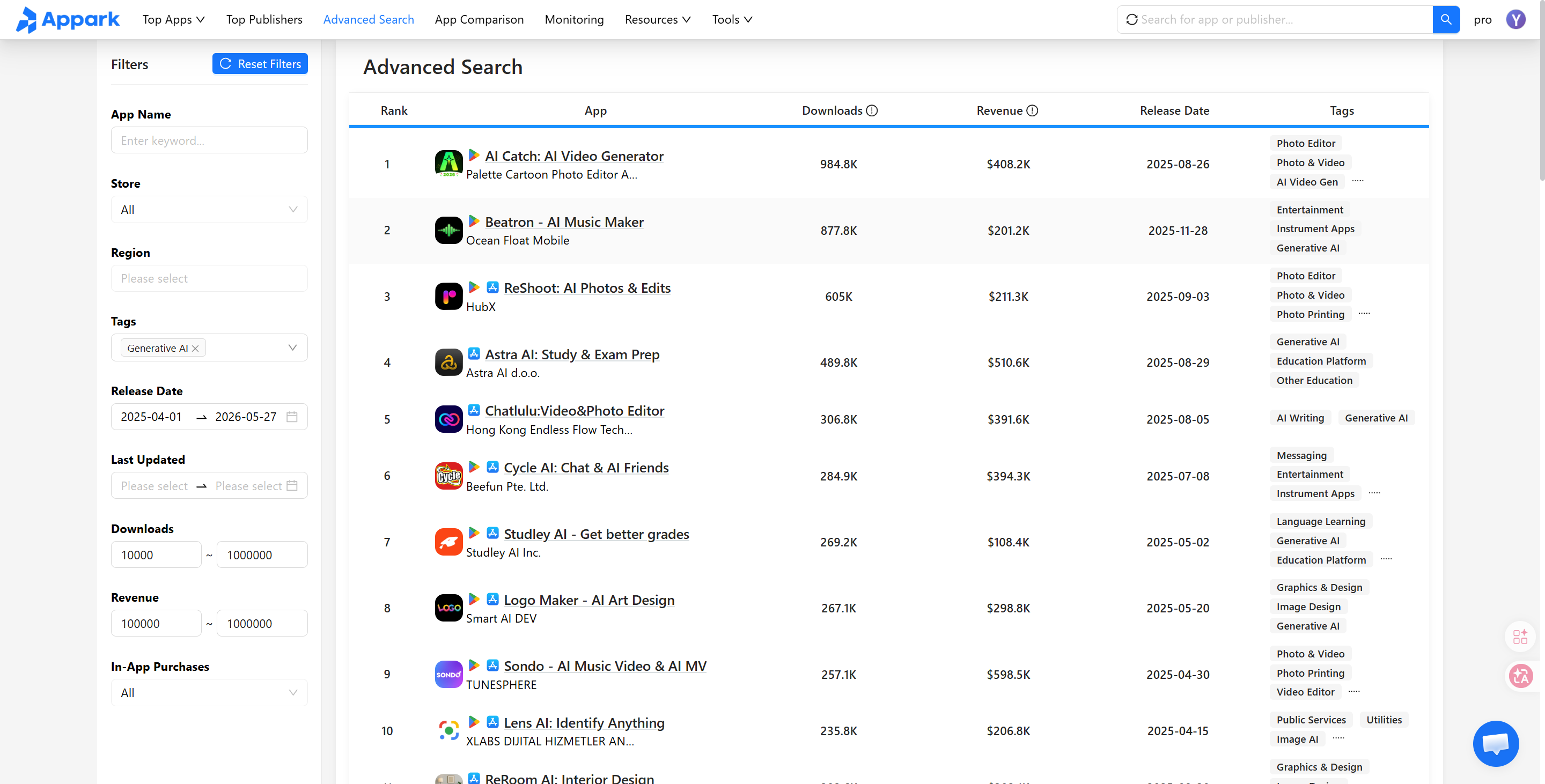
With Appark, you can Start by clicking the Advanced Search engine on Appark to bypass generic keyword filtering and jump straight into a multi-dimensional criteria matrix. Then, you can narrow your search globally by applying specific industry Tags—such as "Generative AI" or "AI Assistant"—that align with current product trends. To refine this query, layer in exact parameters for release dates, download volumes, and revenue metrics to instantly surface freshly launched MVPs pulling in immediate user validation.
Step 2: Deeply Analyze Competitor Performance
Once Appark's query filters help you isolate a rising star niche, your next objective is to run a deep architectural and performance audit against the established category leaders. You cannot afford to analyze their data in a static vacuum; you need to map out their historical growth vectors.
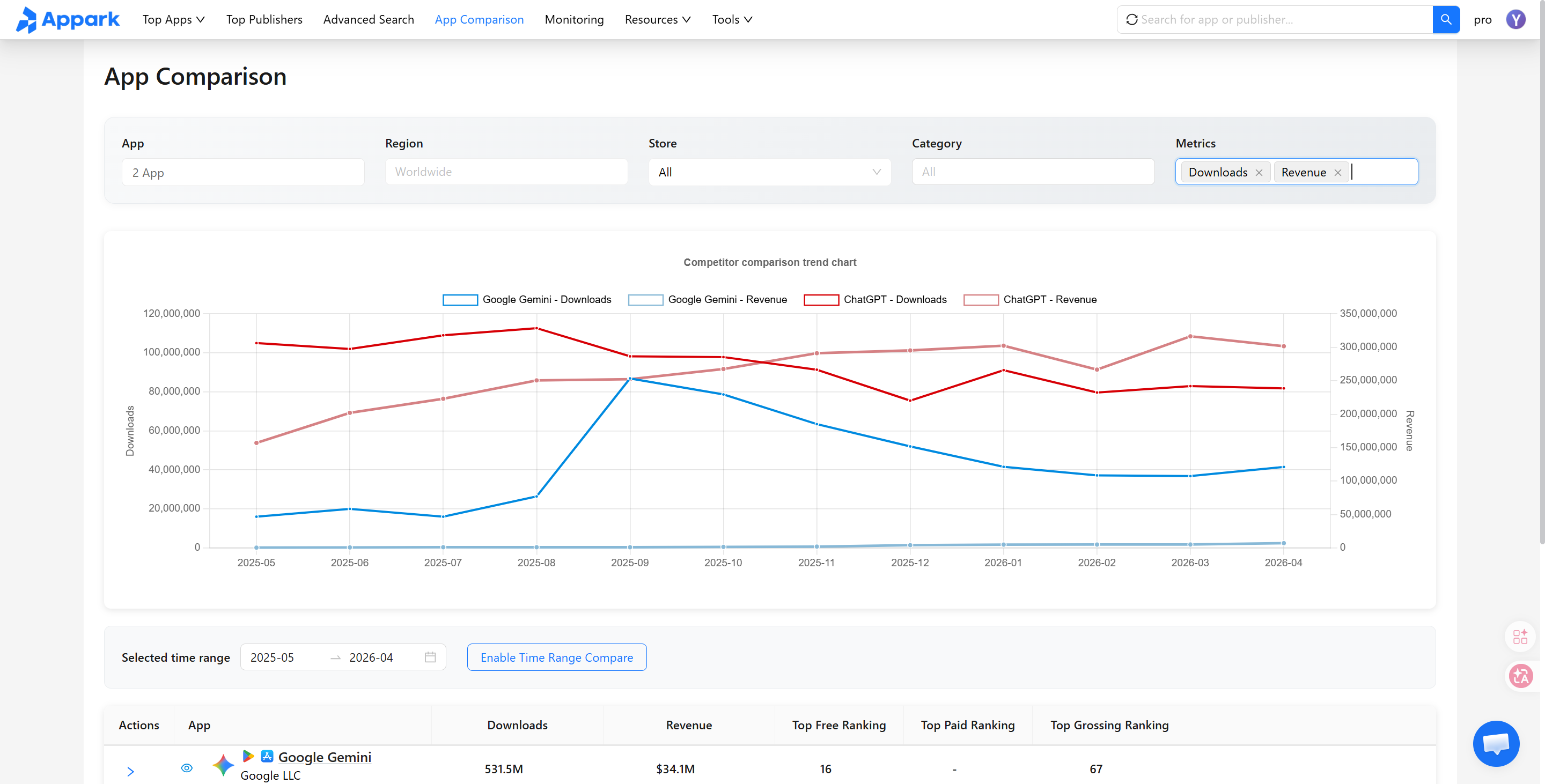
You can drop your newly discovered competitors directly into Appark’s App Comparison analytical dashboard. The platform completely eliminates manual spreadsheet logging by automatically rendering an interactive Competitive Trend Graph .
Within this unified visualization, you can overlay multiple applications (such as plotting Google Gemini side-by-side against ChatGPT) to track their correlation over rolling multi-month periods. You can toggle seamlessly between different data indicators—including **Downloads **, **Revenue **,Top Free Rankings, Top Paid Rankings and Top Grossing Ranking. By watching these curves intersect, you can instantly pinpoint the exact moment a competitor's on-device AI update or micro-frontend rollout caused a massive, real-world surge in their premium subscription retention.
Step 3: Monitor Competitors and Track Iterations
Mobile product management in 2026 is a non-stop battle. Category leaders pivot their localized pricing tiers, update application store assets, and push patch revisions at an exhaustive pace. Manually auditing dozens of competitor store pages every morning is an operational bottleneck that ruins engineering velocity.
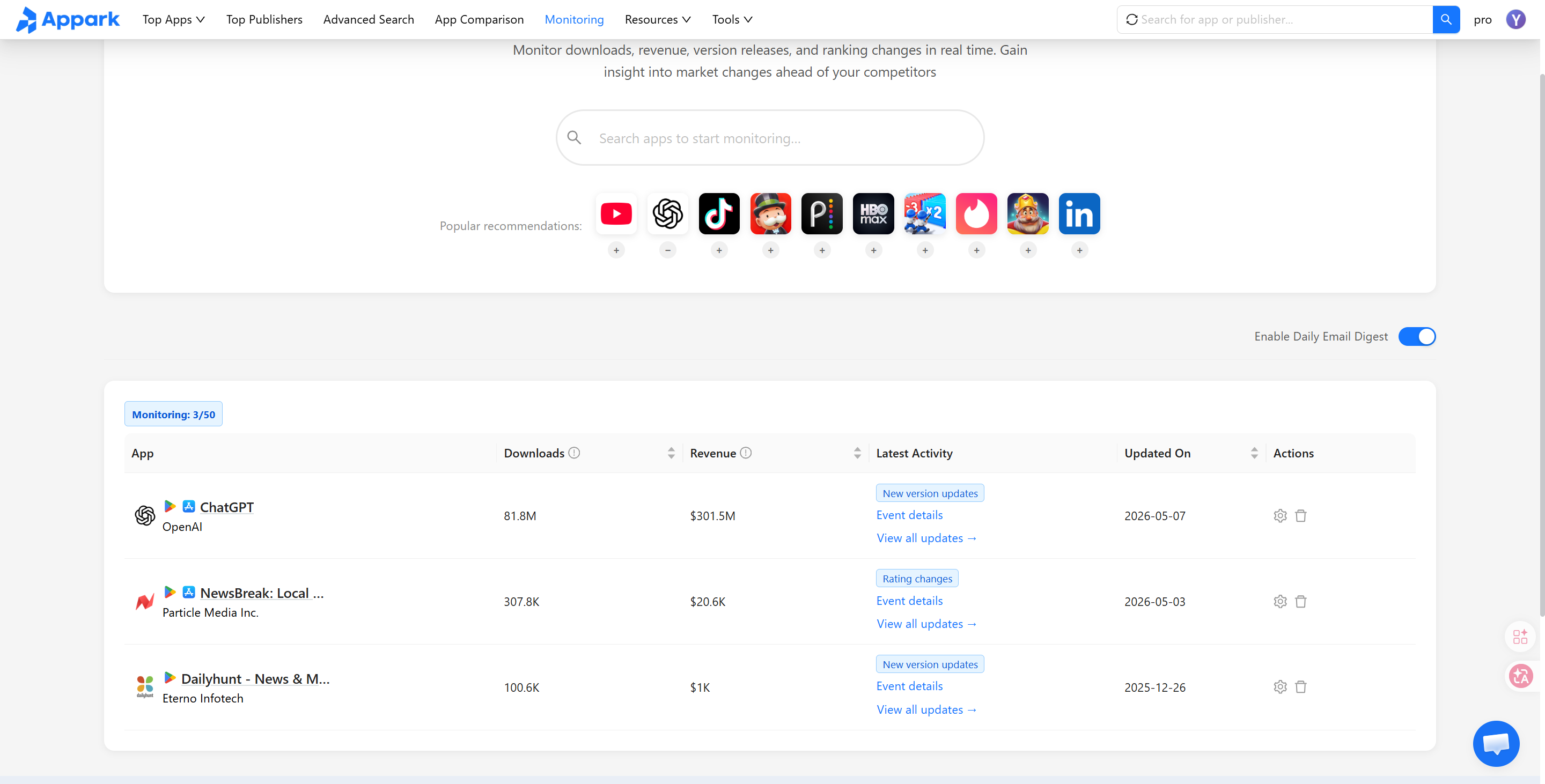
To build a long-term defensive moat around your product pipeline, you can offload this operational overhead to Appark's automated Monitoring List. By adding your core competitors to this centralized dashboard, the platform keeps a continuous, live pulse on their core metrics—including absolute download volumes, revenue adjustments, change timestamps, and operational status updates.
The platform’s monitoring engine flags critical structural events in real-time, highlighting exact incident contexts such as Rating Changes or New Version Updates. To build a completely set-and-forget growth operation, simply flip the "Turn on Daily Email Report" switch. Once enabled, you can close the browser tab entirely; Appark will automatically compile all competitor behavioral shifts, metadata adjustments, and performance anomalies, dropping a pristine executive brief straight into your inbox every single morning.
Frequently Asked Questions
To help you quickly realign your roadmap, we have synthesized the most pressing inquiries regarding macro Mobile App Development Trends currently circulating among product leads, engineering managers, and growth teams regarding the mobile landscape this year.
Q1: Will low-code and no-code tools replace professional developers in 2026?
A: No, they accelerate prototyping, not production scaling. While low-code tools now handle 75% of new application workflows to validate MVPs in days , production-grade scaling, local memory management, and specialized backend architecture still strictly require custom engineering.
Q2: Is cross-platform performance truly on par with native development?
A: Yes, for 95% of mainstream non-gaming applications. Frameworks like Flutter, React Native, and Kotlin Multiplatform deliver native-like user experiences with near-zero latency , while maintaining a single core codebase that cuts development and maintenance overhead in half.
Q3: What factors should founders prioritize when hiring an app development company?
A: Founders must look past generic pricing and prioritize technical scalability planning, AI integration expertise, proven cloud infrastructure knowledge, strict security and compliance standards, and long-term technical support over transactional relationships.
Stop Guessing and Start Building with Appark
The reality of the 2026 app market is straightforward: building features based on pure intuition is the fastest way to burn through your runway. With 75% of new application workflows leveraging low-code platforms and over 40% of mobile AI running directly on-device, you are up against data-driven growth machines. To keep your application out of the 90% graveyard of forgotten products, you need a clear line of sight into what is actually working in the live market right now.
Stop wasting valuable development cycles on dead feature lanes. Use Appark’s Advanced Search matrix to target specific niches, cross-reference market shifts via dynamic Rankings charts, and let the automated Monitoring List handle long-term tracking by dropping a clean executive brief straight into your inbox every single morning.
The velocity of current Mobile App Development Trends means the market arbitrage window closes fast. Equip your product team with the right telemetry before your next deploy.
👉 Create Your Free Appark Account Now and Uncover Your Niche’s Next Growth Arbitrage.