


Why Mobile App Competitor Analysis Matters Before Startup?

If you’re preparing to launch a new mobile app — especially in gaming — doing a mobile app competitor analysis before you start is not optional. It’s strategic.
With app competitor analysis tools, you can avoid blind spots, uncover opportunities, and make data-driven decisions — ideally, long before your first user installs.
That’s where Appark comes in: a unified dashboard that lets you run a full competitor comparison in seconds — across downloads, revenue, store rankings, and more — on both iOS App Store and Google Play.
Let’s walk through why this matters, what good competitor analysis looks like — and how you can practically leverage Appark (or similar tools) to build a smarter launch strategy.
What Is “App Competitor Analysis” — and Why You Should Start With It
At its core, app competitor analysis is more than glancing at top charts. It means systematically studying peers and potential rivals: their store positioning, performance metrics, monetization patterns, growth trends, and even user sentiment.
In markets flooded with apps — and especially crowded sub-verticals like mobile games — you don’t just compete with similar apps: you compete with global developers, localized clones, new niche entrants, and even cross-genre substitutes.
A well-structured competitor analysis helps you:
- Identify direct competitors (same genre/function), indirect competitors (similar user needs), and regional variants across markets.
- Understand how they monetize (ads, IAP, subscriptions), where their strengths lie (top downloads, high ratings, loyal users), and where they may be vulnerable (poor reviews, weak retention, outdated creatives).
- Spot unserved niches — maybe a feature players repeatedly ask for, or a user pain point common across competitor reviews — that you can address with your own offering.
For gaming apps, where UA (user acquisition), retention, monetization and ASO (App Store Optimization) interplay tightly — competitor insight becomes a core pillar of a “launch-ready” strategy.
Risks of Skipping Competitor Analysis — Why Many Startups Fail
Some teams rush to build and launch their app, thinking if the gameplay is solid (or the idea is unique), users will come. But skipping competitor analysis leaves you exposed to a number of risks:
- You might miss emerging threats. A small game with modest installs today could rapidly rise — especially if they iterate quickly, optimize ASO, or launch paid UA campaigns. Without monitoring, you may only realize too late.
- You might misjudge user demand. Store ratings alone don’t tell the full story — reviews can reveal recurring complaints, missing features, painful onboarding flows, or monetization friction. Ignoring reviews (or user sentiment) means ignoring what players truly care about.

- You may optimize blindly — targeting popular features rather than unmet needs. Without seeing what competitors already offer (and where they fall short), your “unique selling points” may end up redundant.
- Your ASO and UA investment might underperform. With thousands of new apps launched every day, it’s easy to get lost in the noise. Without proper competitor and market context, even well-crafted ASO/ad efforts can underdeliver. In short — building without reference is like sailing blind in a storm.
What Good Competitor Analysis Looks Like (and How Appark Helps)
✅ Multi-dimensional benchmarking
A robust competitor analysis doesn’t stop at “who’s popular.” It compares across multiple dimensions:
- Downloads & revenue — to gauge real traction and monetization strength.
- Store rankings & category performance — to see where competitors appear (search, browse, “similar apps”, top charts) and how consistent they are.
- Metadata & creatives (ASO elements) — titles, descriptions, keywords, icons, screenshots/video previews. These affect first impressions and conversion rate.
- User reviews & ratings — to understand user sentiment: what users love, what frustrates them, what features they ask for. Great source for product-level insight.
- Update/launch cadence and marketing/UA behavior — frequency of updates, changes in features or creatives, paid UA campaigns, regional expansion. These often hint at strategic moves even before performance peaks.
With a well-designed competitor matrix (e.g. using spreadsheets or dashboards), you get a holistic view — not just flashy chart positions but realistic strategic positioning.
✅ Continuous monitoring, not one-off research
Markets shift fast: new apps launch daily, algorithms change, user preferences evolve. What looked like a gap yesterday may be saturated tomorrow. That’s why good competitor analysis is ongoing. A tool like Appark — which supports cross-platform tracking (iOS + Android), global region coverage, and up-to-date data — becomes especially valuable.Instead of manually checking store charts or scraping data, you get instant visibility: downloads, revenue estimates, ranking shifts — all in one place.
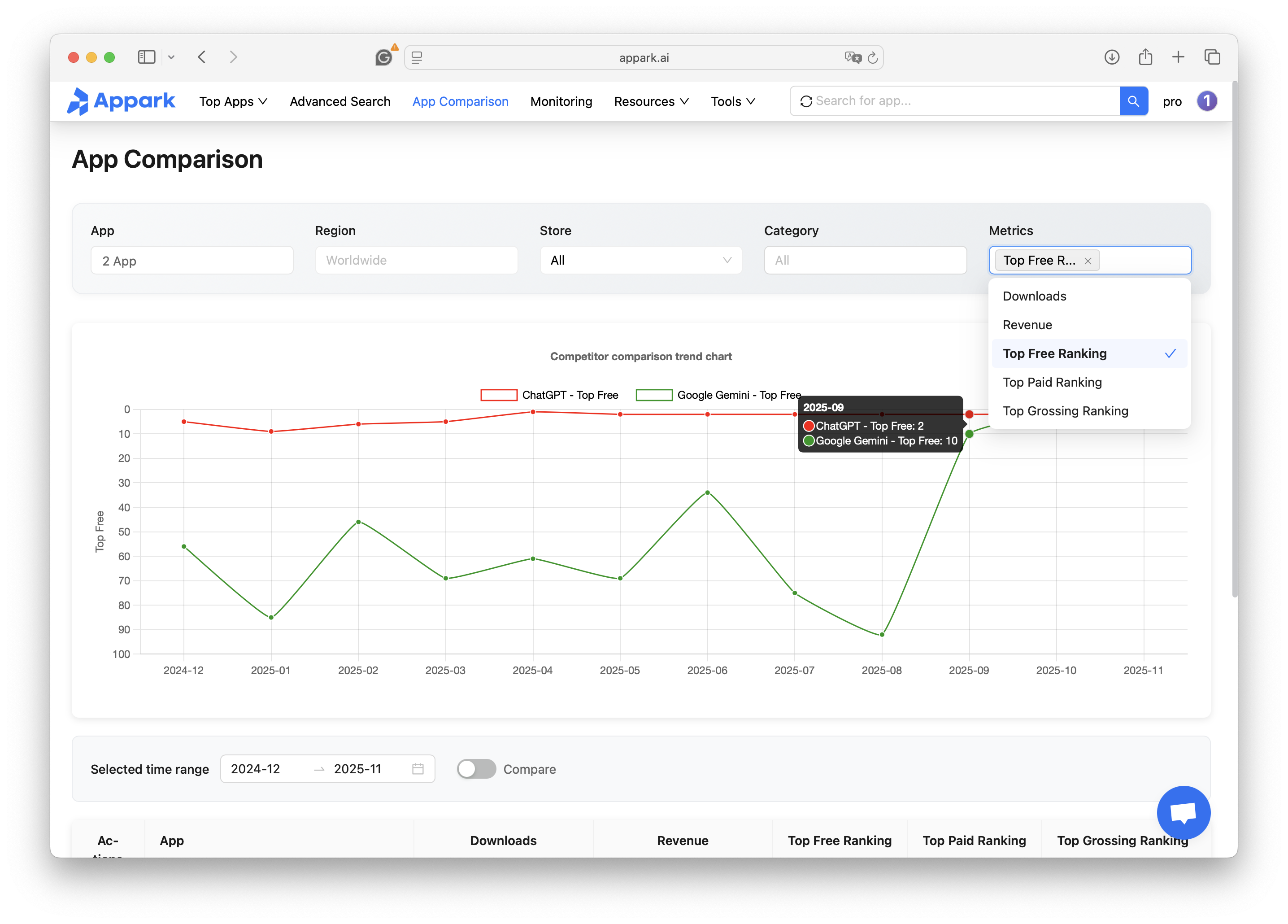
✅ Insights → Action: From Data to Strategy
Numbers on a dashboard are just the start. The real value comes when you turn those numbers into strategy:
- Identify underserved regions or user segments (e.g. a competitor doing well only in certain countries).
- Spot weaknesses — maybe a competitor has many installs but poor reviews or frequent complaints — and build better UX / retention / monetization.
- Inform UA and launch budget decisions: which markets, features, or user acquisition channels to prioritize.
- Shape roadmap and product differentiation: design around gaps competitors ignore.
For Mobile Game Startups: Why This Approach Is Even More Critical
If you’re building a mobile game, this layered, data-driven competitor analysis matters especially.
- The mobile-game market is saturated: hundreds or thousands of games compete for attention daily. Without standout visibility, even great games may languish.
- User acquisition (UA) costs are rising — making organic retention, ASO, and product-market fit more important than ever. A solid competitor analysis helps reduce UA waste by improving conversion, retention, and lifetime value strategy.
- Games are often differentiated by features, mechanics, monetization models, and user experience (onboarding, retention loops, social features). Competitor analysis gives you real data on what works and what doesn’t — not just gut feelings.
- For cross-platform launches (iOS & Android, different regions), understanding regional competitor dynamics is key. A game that flops in one region may perform well in another depending on local competition and user preferences.

Why Appark (and Tools Like It) Are Strategic Assets — Not Just Nice-to-Have
There are many analytics, ASO and market-intelligence tools on the market (e.g. MobileAction, Sensor Tower, App Radar, etc.).
What makes Appark stand out (and especially suited for your “startup before launch” context):
- Unified cross-platform and cross-region dashboard — lets you compare iOS & Android, different countries, and multiple competitors at once. This saves you from jumping across tools or manually gathering data.
- Speed and simplicity — within seconds you can build a competitor list, get key metrics (downloads, revenue, rankings) and start comparative analysis. For pre-launch teams, this reduces overhead and helps make quick, data-informed decisions.
- Support for ongoing monitoring — not just a one-time snapshot. As the market shifts, you can track new competitors, growth spurts, changes in monetization or ASO strategy. That’s critical for agile game studios or lean startups.
- Actionable insights beyond raw data — integrated competitor comparison helps you benchmark realistically, identify opportunity gaps, and shape your product, UA, and monetization strategy.
In short: tools like Appark turn competitor analysis from a cumbersome manual task into a scalable, repeatable part of your growth process.
Final Thoughts
If you’re building a new mobile game (or app), investing time in mobile app competitor analysis — and using modern app competitor analysis tools — isn’t optional. It’s strategic.

By doing so before launch, you not only reduce risk, but also gain clarity — on who you compete against, what gaps exist, where your opportunity lies, and how to position your product and marketing smartly.
For game developers and growth-oriented teams, combining market intelligence, ASO, UA plans, and a data-driven roadmap gives you a fighting chance in an increasingly competitive landscape.
With Appark, you can streamline that entire process — from competitor discovery to continuous monitoring — giving you a real competitive edge.